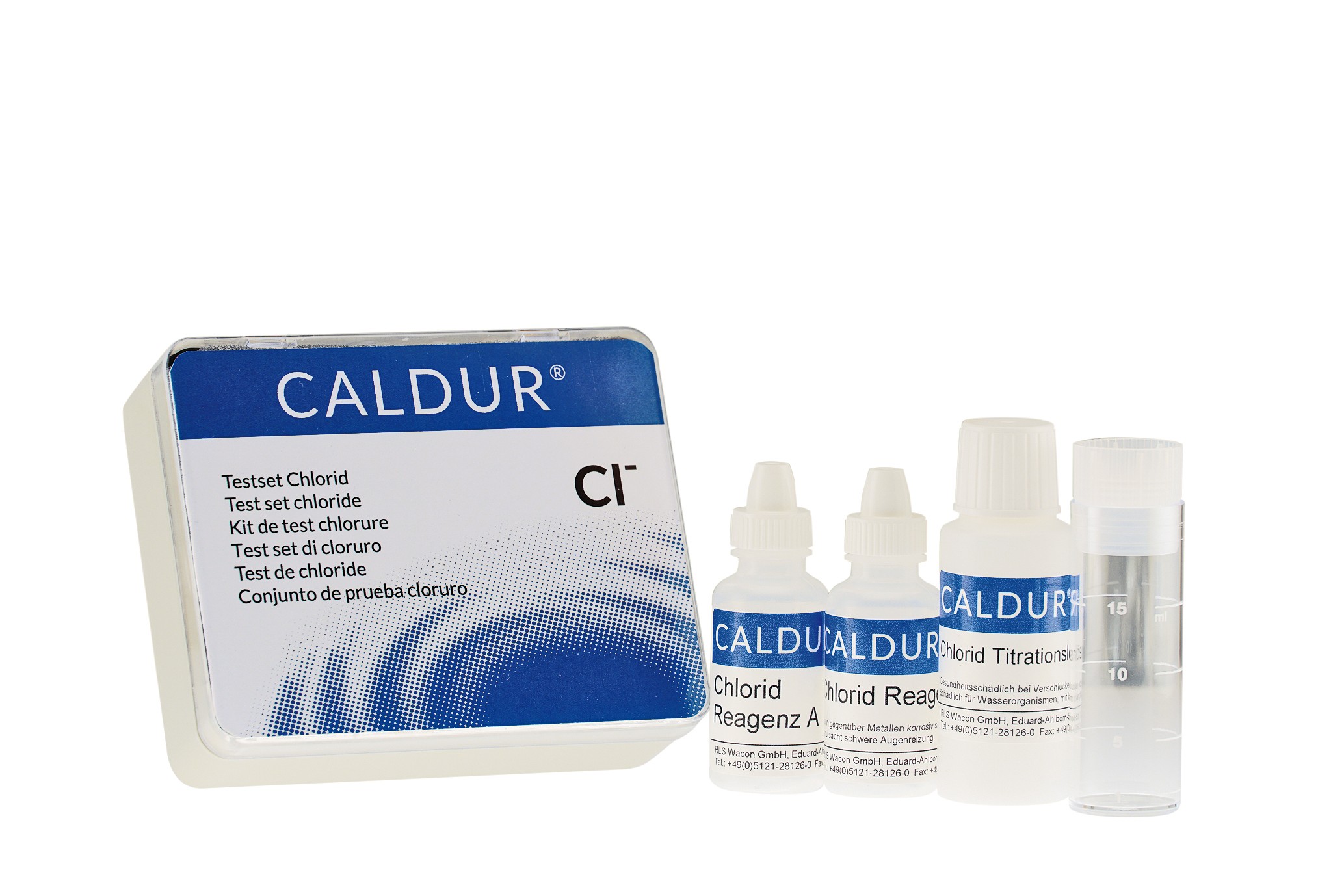
CALDUR® Chloride test set – Titration
What is chloride measured for?
Chloride is one of the most important anions in natural waters and plays a decisive role in the assessment of water quality. As a salt of hydrochloric acid, chloride occurs in almost all natural waters and enters the water from various sources: the dissolution of minerals, road salt in winter, industrial discharges and municipal wastewater.
Monitoring the chloride concentration is particularly important for assessing corrosion potential in piping systems. High chloride levels can significantly accelerate the corrosion of metallic materials, especially stainless steel and galvanized steel. Regular chloride monitoring is therefore essential in drinking water supplies and industrial cooling circuits.
The limit value for drinking water in Germany is 250 mg/l (Drinking Water Ordinance). This value is primarily intended to prevent corrosion damage and ensure a pleasant taste, as higher chloride concentrations can give the water a salty taste.
Chloride measurement is also particularly relevant in the food industry, in swimming pools, in electroplating and for monitoring groundwater and surface water. Determining the chloride content allows conclusions to be drawn about possible contamination from road salt, waste water or industrial discharges.
How does the test set work?
The CALDUR® Chloride test set uses the proven mercurimetric titration method with silver nitrate. In this method, a titration solution is added to the water sample, whereby the chloride ions react with mercury(II) ions and form a sparingly soluble precipitate.
Measuring principle: After adding reagent A (indicator) and reagent B (buffer) to the water sample, the titration solution is added drop by drop. The end point of the titration is indicated by a characteristic color change. The number of drops used corresponds directly to the chloride concentration in mg/l.
Calculation: Each drop of titration solution corresponds to 5 mg/l chloride. With 10 drops up to the color change, the chloride concentration is therefore 50 mg/l.
The titration method is internationally recognized and is characterized by high accuracy and reproducibility. It is particularly suitable for applications where a quantitative determination in the medium concentration range is required.
Advantages of the CALDUR® test set
- Quick analysis in just 3 minutes
Ideal for routine on-site inspections – saves time and enables immediate decisions
- High precision due to drop-by-drop titration
Precise results thanks to proven mercurimetric method with silver nitrate
- 100 determinations per set – economical in continuous use
Cost-efficient for regular checks in waterworks, industry and laboratories
- Wide measuring range from 5-250 mg/l Cl-
Coverage of the entire relevant concentration range for drinking water and process water
- Easy handling without special equipment
No additional technology required – ideal for quick tests on site and in the laboratory
- Robust, waterproof plastic housing with hinged lid
Safe transportation and protection of reagents – durable and reliable
Measuring range
| Number of drops |
Chloride concentration |
| 1 drop |
5 mg/l Cl- |
| 5 drops |
25 mg/l Cl- |
| 10 drops |
50 mg/l Cl- |
| 20 drops |
100 mg/l Cl- |
| 30 drops |
150 mg/l Cl- |
| 50 drops |
250 mg/l Cl- |
Read intermediate values:
The chloride concentration is calculated directly from the number of drops multiplied by 5 mg/l.
Example: 15 drops = 75 mg/l Cl-
Number of possible determinations
You can carry out 100 measurements with one CALDUR® Chloride test kit.
This refers to the quantity of reagents contained.
Measuring accuracy and reproducibility
Resolution: 5 mg/l per drop
Reproducibility: Very good if the application instructions are followed
Interference: Bromide, iodide and cyanide can influence the result. Pre-filtration is recommended for strongly colored or cloudy samples.
What to do if measured values are out of range?
Measured value > 250 mg/l
| Dilution |
Procedure |
Calculation of the measured value |
| 1:1 |
5 ml sample + 5 ml distilled water |
Measured value x 2 |
| 1:4 |
2 ml sample + 8 ml distilled water |
Measured value x 5 |
| 1:9 |
1 ml sample + 9 ml distilled water |
Measured value x 10 |
Measured value < 5 mg/l
The measured value is below the detection limit. This is generally not critical and indicates
that the chloride concentration is very low.
Specifications at a glance
Reagents (reagent A, B, titration solution)
| Property |
Value |
| Parameters |
Chloride (Cl-) |
| Item number |
31-071530 |
| Method |
Titration (mercurimetric) |
| Measuring principle |
Droplet titration with color change |
| Measuring range |
5 to 250 mg/l Cl- |
| Resolution |
5 mg/l per drop |
| Analysis time |
3 minutes |
| Number of determinations |
100 |
| Packaging |
Hinged lid box |
| Packaging size |
103 x 91 x 36 mm |
| weight |
approx. 150 g |
| Scope of delivery |
| 3 reagent bottles (reagent A, reagent B, titration solution) with detailed labeling |
| 1 test tube with 10 ml scale |
| Detailed operating instructions (DE/EN) |
| Safety data sheets for all reagents |
| Robust hinged lid box (103 x 91 x 36 mm) |
Reagent details
| Reagent |
Volume |
Shelf life |
Notes |
| Reagent A |
5 ml |
36 months (36M) |
Reagent, shake before use |
| Reagent B |
10 ml |
36 months (36M) |
Buffer, shake before use |
| Titration solution |
30 ml |
36 months (36M) |
Silver nitrate solution, shake before use |
Shelf life: The shelf life starts from the date of manufacture (printed on the bottle).
After opening, the reagents should be used within 12 months.
Store the test kit in a dry, cool place (10-25°C) and away from direct sunlight.


 pH determination in the neutral range using a color chart (pH 5-8)


