Water Hardness Calculator
Convert your reading between all units in seconds — °dH, °e, ppm CaCO₃, grains per gallon, mmol/l and mval/l. Also for carbonate hardness, phosphate, sulfite, nitrate, ammonium and conductivity.
Results without warranty · The scale follows the common mg/L CaCO₃ classification (for orientation).
Total hardness
The sum of calcium and magnesium ions — the key value against limescale.
- Definition
- Total hardness is the sum of the dissolved calcium and magnesium ions. It is stated in °dH, ppm CaCO₃ (mg/L) or grains per gallon (gpg): 1 °dH = 17.8 ppm CaCO₃ = 1.04 gpg.
- Why it matters
- Hardness is the most important value for limescale. When water gets hot, limescale forms in boilers, heat exchangers, tanks and pipes. This costs energy and causes more maintenance.
- Where measured
- At the inlet (raw-water hardness), downstream of the softener (residual-hardness check) and continuously in boiler and cooling water.
- Typical values
- Tap water ranges roughly 60–400 ppm CaCO₃ (soft to very hard). Softened boiler feed water should reach a residual hardness near 0.
- Measurement
- Titration drop by drop, a quick yes/no limit test, or continuous online analysis (SYCON / LIMES).
- Good to know
- Carbonate hardness is the part of the total hardness that forms limescale when the water is heated. Water treatment usually looks at both values.
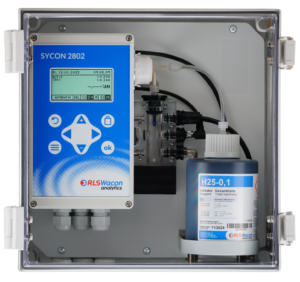
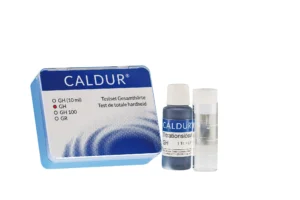
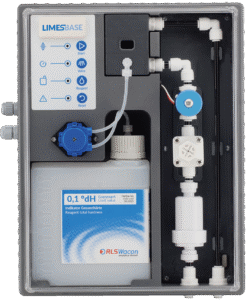
The RLS Wacon water hardness calculator
This tool converts your reading into all common units. It works for total hardness, carbonate hardness and the boiler-water values phosphate, sulfite, nitrate, ammonium and conductivity. Choose a parameter. Enter your value and unit. You get all units, the hardness range and the right test method and products.
Units & conversion
Simple rule: 1 °dH = 17.8 ppm CaCO₃ = 1.04 gpg = 1.78 °f = 1.25 °e = 0.178 mmol/l. Use it to compare values from manufacturers, labs and water suppliers.