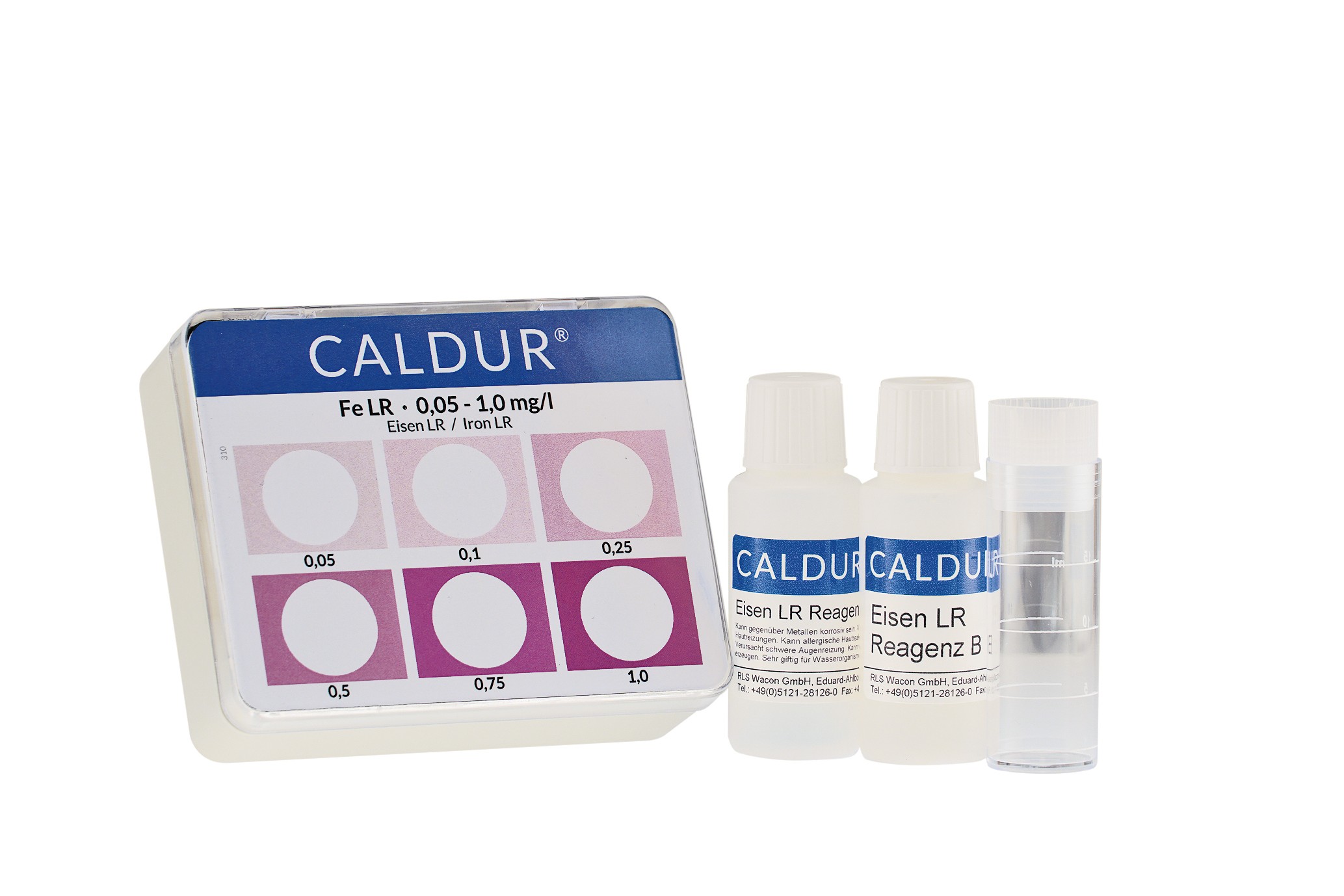
CALDUR® Iron LR – Colorimetric
Determination of iron in water using a color chart (0.05-1.0 mg/l Fe)

Private customers can also find our range in our partner store Ampha-Analyse.
Reagent for CALDUR® Iron LR – Colorimetric:
See also:

CALDUR® Iron LR Test Set – Colorimetric
What is iron measured for?
Iron is a naturally occurring element that can be found in almost all bodies of water and groundwater sources. Although iron is essential for the human body, too high a concentration in drinking water can lead to undesirable effects. Elevated iron levels cause a brownish discoloration of the water, a metallic taste and can lead to deposits in pipes and household appliances.
The limit value for drinking water in Germany is 0.2 mg/l (Drinking Water Ordinance). However, significantly higher values are measured in many wells and groundwater sources, which is why regular monitoring is essential. Monitoring the iron content is particularly important in water treatment, swimming pools and industrial processes.
Iron can enter the water from various sources: natural leaching from iron-containing rock layers, corrosion of iron pipes, industrial discharges or through iron-containing additives in water treatment. The oxidation of dissolved iron(II) to iron(III) leads to the characteristic rusty brown coloration and turbidity of the water.
How does the test set work?
The CALDUR® Iron LR Test Set – Colorimetric works according to the proven ferrozine method. Ferrozine forms an intense violet color complex with iron(II) ions, the intensity of which is proportional to the iron concentration. By adding two reagents to the water sample, any iron(III) present is first reduced to iron(II) in order to determine the total iron concentration.
After a reaction time of 4 minutes, the measured value is determined by direct color comparison with a supplied 6-stage color chart. This colorimetric method enables fast and reliable on-site determination without the need for expensive laboratory equipment. Optionally, the evaluation can also be carried out photometrically with the WINLAB Data Line photometer, which enables an even more precise measurement.
Advantages of the CALDUR® test set
- Quick analysis in just 4 minutes
Ideal for on-site use – saves time and enables immediate decisions
- High precision in the low concentration range (from 0.05 mg/l)
Perfect for compliance with the Drinking Water Ordinance and for sensitive applications
- 150 provisions per set – economical in continuous use
Cost-efficient for regular checks in waterworks, industry and private wells
- Can be used colorimetrically and optionally photometrically
Flexible for simple on-site tests or precise laboratory analyses with photometer
- Easy handling without special equipment
No additional technology required – ideal for quick tests on the go
- Robust, waterproof plastic housing with hinged lid
Safe transportation and protection of reagents – durable and reliable
Areas of application
Carrying out the measurement:
- Fill water sample into test tube up to the 10 ml mark
- Add 5 drops of reagent A and mix
- Add 5 drops of reagent B and mix
- Wait 4 minutes until the color has fully developed
- Evaluation by color comparison with color chart or photometric measurement
Tip for best results
For best results, the water sample should be clear and free of suspended solids.
If the water is cloudy, pre-filtration with a filter paper (e.g. Whatman No. 1) is recommended.
Important notes
- Bring reagents to room temperature before use
- Adhere exactly to waiting times for precise measurement results
- Avoid direct sunlight during the measurement
- Rinse test tubes thoroughly with distilled water after use
Measuring range
| Measuring level | Description |
|---|---|
| 0.05 mg/l | Very low concentration (light violet) |
| 0.1 mg/l | Low concentration (violet) |
| 0.25 mg/l | Elevated concentration (limit value exceeded) |
| 0.5 mg/l | Medium concentration (clearly violet) |
| 0.75 mg/l | High concentration (intense violet) |
| 1.0 mg/l | Very high concentration (dark violet) |
If the color lies between two fields, you can form the mean value
(e.g. between 0.1 and 0.25 mg/l = approx. 0.15-0.2 mg/l).
Number of possible provisions
You can carry out 150 measurements with one CALDUR® iron LR test set.
This refers to the quantity of reagents contained.
Measuring accuracy and reproducibility
Readability: ± 1 color level
Reproducibility: Very good if the application instructions are followed
Interferences: Turbidity and coloration of the sample can influence the result (filter the sample if necessary)
What to do if measured values are out of range?
Measured value > 1.0 mg/l
| Dilution | Procedure | Calculation of the measured value |
|---|---|---|
| 1:1 | 5 ml sample + 5 ml distilled water | Measured value × 2 |
| 1:4 | 2 ml sample + 8 ml distilled water | Measured value × 5 |
| 1:9 | 1 ml sample + 9 ml distilled water | Measured value × 10 |
Measured value < 0.05 mg/l
The measured value is below the detection limit. This is generally not critical and indicates
that the iron concentration is very low (water is harmless with regard to iron).
Specifications at a glance
Reagents (reagent A, B)
| Property | Value |
|---|---|
| Parameters | Iron (Fe) |
| Item number | 31-072310 |
| Method | Colorimetric (ferrozine) |
| Measuring principle | Color comparison with 6-stage color chart |
| Measuring range | 0.05 to 1.0 mg/l Fe |
| Color scale | 6 measuring levels (0.05 / 0.1 / 0.25 / 0.5 / 0.75 / 1.0 mg/l) |
| Analysis time | 4 minutes |
| Number of provisions | 150 |
| Number of reagents | 2 (reagent A, B) |
| Packaging | Hinged lid box |
| Packaging size | 103 x 91 x 36 mm |
| weight | approx. 150 g |
| Scope of delivery |
|---|
| 2 reagent bottles (reagent A, B) with detailed labeling |
| 1 test tube with 10 ml scale |
| 1 color card with 6 measuring levels |
| Detailed operating instructions (DE/EN) |
| Safety data sheets for all reagents |
| Robust hinged lid box (103 x 91 x 36 mm) |
Reagent details
| Reagent | Volume | Shelf life | Notes |
|---|---|---|---|
| Reagent A | 15 ml | 24 months (24M) | Reducing agent, shake before use |
| Reagent B | 15 ml | 24 months (24M) | Ferrozine solution, shake before use |
Shelf life: The shelf life starts from the date of manufacture (printed on the bottle).
After opening, the reagents should be used within 12 months.
Store the test kit in a dry, cool place (10-25°C) and away from direct sunlight.
Additional information
| Packaging | Hinged lid box, Refill pack |
|---|---|
| Product category | Testset |
Flyer
Operating instructions

Similar articles:
Related products
-
 pH determination in the acidic range using a color chart (pH 2-5)
-
-


