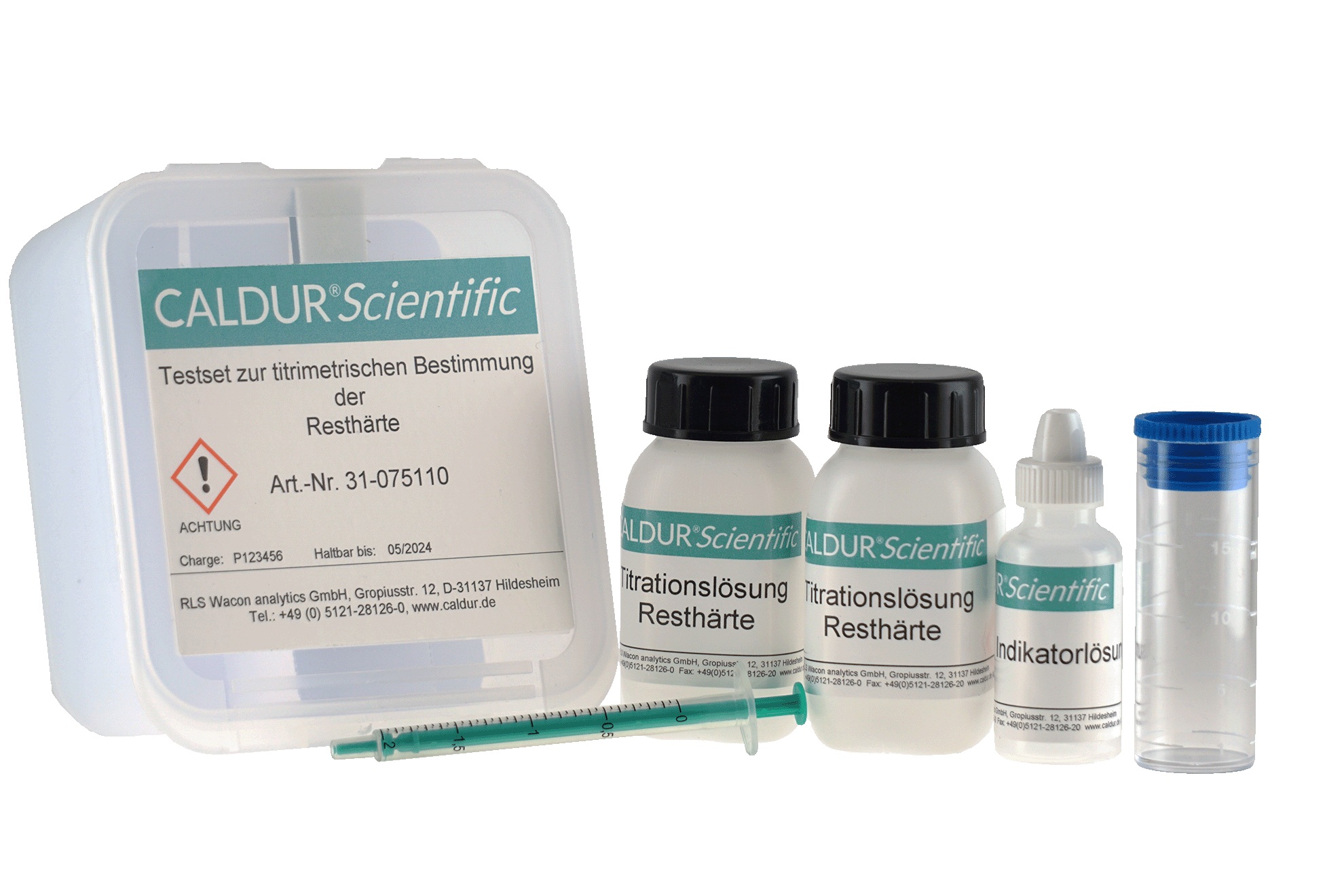
Caldur® Carbonate hardness – Scientific
Determination of carbonate hardness in water by spray titration (0-20 °dH)

Private customers can also find our range in our partner store Ampha-Analyse.
Reagent for Caldur® Carbonate hardness – Scientific:
See also:
CALDUR® Carbonate Hardness Scientific Test Set – Syringe titration
What is carbonate hardness measured for?
Carbonate hardness (temporary hardness) is an important parameter in water chemistry and provides information about the concentration of hydrogen carbonate and carbonate ions in the water. It is part of the total hardness and plays a decisive role in the buffering capacity of the water (pH stability).
Monitoring carbonate hardness is essential in boiler systems, as carbonate hardness precipitates and forms scale when heated. This impairs heat transfer and can lead to serious damage to the system. The carbonate hardness in boiler water should be as low as possible (< 0.5 °dH). The Scientific series from CALDUR® offers maximum precision and user-friendliness thanks to the innovative syringe titration. Intermediate values can be read directly on the scale without having to count drops.
How does the test set work?
The CALDUR® Carbonate Hardness Scientific test set uses a precise dosing syringe for titration. Two reagents are added to the water sample, then the titration solution is added with the syringe. The measured value is read directly from the syringe scale – no drop counting required!
This method enables a continuous reading in the range from 0 to 20 °dH and offers significantly higher precision than conventional drop titrations. The resolution is at least 0.5 °dH, whereby intermediate values can also be read without any problems.
Advantages of the CALDUR® test set
- Quick analysis in just 1 minute
Ideal for regular checks – faster than conventional drip titrations
- Highest precision through syringe titration
Stepless reading enables intermediate values – no drop counting required
- Wide measuring range from 0 to 20 °dH
Covers all practical areas from boiler water to raw water
- Approx. 200 provisions per set – economical in continuous use
Particularly economical due to high number of possible measurements
- Convenient handling with dosing syringe
Ergonomic design for fatigue-free working
- Robust plastic housing
Safe transportation and protection of components
Areas of application
Carrying out the measurement:
- Fill water sample into test tube
- Add reagent 1 and reagent 2 according to the instructions and mix
- Fill the dosing syringe with titration solution and note the initial value
- Slowly add titration solution while swirling the sample
- Stop adding when the color changes from green to red/orange
- Read the measured value directly from the syringe scale
💡 Tip for best results
For best results, the water sample should be clear and free of suspended solids.
The color change from green to red/orange is clearly visible.
The syringe method enables very precise readings without drop counting.
Carry out the titration slowly in order to hit the end point exactly.
⚠️ Important notes
- Bring reagents to room temperature before use
- Rinse dosing syringe with distilled water before and after use
- Carry out titration slowly to avoid over-titration
- View the color change against a white background
- Clean all components thoroughly after use
Measuring range
| Measuring range | Resolution | Sample quantity |
|---|---|---|
| 0 to 20 °dH | Infinitely variable (min. 0.5 °dH) | Variable sample quantity |
The syringe scale enables continuous reading. You can read precise intermediate values directly,
without being limited to integer drops.
Number of possible provisions
With a CALDUR® Carbonate Hardness Scientific test set you can carry out approx. 200 measurements.
This refers to the quantity of reagents contained.
Measuring accuracy and reproducibility
Resolution: Infinitely variable, at least 0.5 °dH
Reproducibility: Excellent thanks to precise dosing syringe
Interferences: No significant interferences for typical water samples
What to do if measured values are out of range?
Measured value > 20 °dH
| Dilution | Procedure | Calculation of the measured value |
|---|---|---|
| 1:1 | Equal volumes of sample + distilled water | Read value × 2 = °dH |
| 1:4 | 1 part sample + 4 parts distilled water | Read value × 5 = °dH |
Specifications at a glance
| Property | Value |
|---|---|
| Parameters | Carbonate hardness (CH) |
| Item number | 31-075200 |
| Method | Acid-base titration (syringe method) |
| Measuring principle | Syringe titration with color change |
| Measuring range | 0 to 20 °dH |
| Resolution | Stepless (at least 0.5 °dH) |
| Analysis duration | 1 minute |
| Number of provisions | approx. 200 |
| Packaging | Plastic box |
| weight | approx. 250 g |
| Scope of delivery |
|---|
| 1 precision dosing syringe with scale |
| 1 test tube |
| 2 reagent bottles (60 ml total) |
| Detailed operating instructions (DE/EN) |
| Safety data sheets |
| Robust plastic box |
Reagent details
| Reagent | Volume | Shelf life | Notes |
|---|---|---|---|
| Titration solution 1 | 60 ml | 60 months (60M) | Shake before use |
| Titration solution 2 | 60 ml | 60 months (60M) | Shake before use |
Shelf life: The shelf life starts from the date of manufacture (printed on the bottle).
After opening, the reagents should be used within 18 months.
Store the test kit in a dry, cool place (10-25°C) and away from direct sunlight.
Additional information
| Packaging | Plastic box |
|---|---|
| Product category | Testset |
Flyer
Operating instructions
Instructions for use
Instructions for use
Similar articles:
Related products
-
 pH determination in the acidic range using a color chart (pH 2-5)
 -
-


