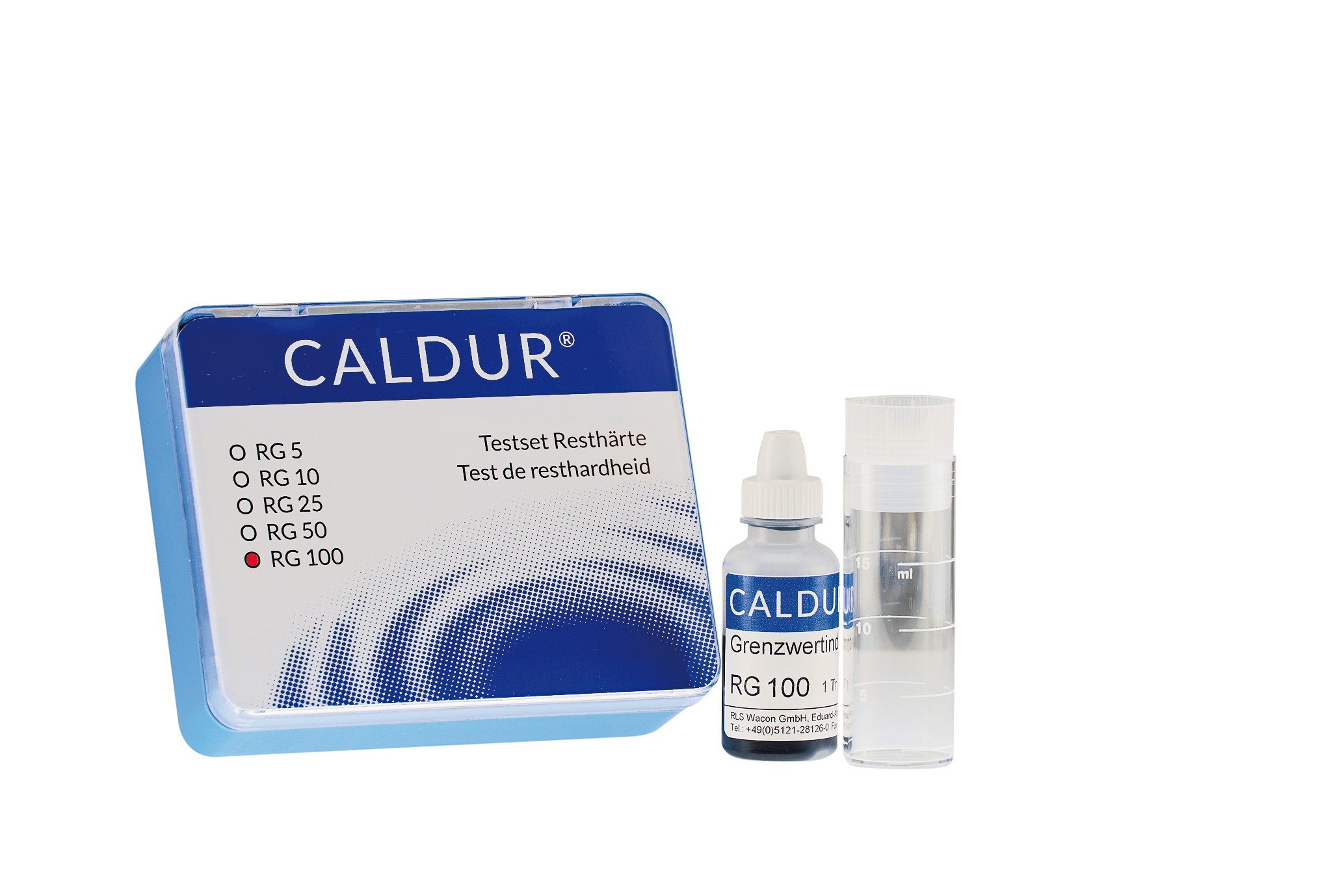
Caldur® residual hardness RG 100 – limit value
Residual hardness limit value determination in the water (limit value: 1.0 °dH)

Private customers can also find our range in our partner store Ampha-Analyse.
Reagent for Caldur® residual hardness RG 100 – limit value:
See also:
CALDUR® Residual hardness test set RG 100 – Limit value method
What is residual hardness measured for?
Residual hardness is a decisive parameter when monitoring water softeners and
ion exchangers. After water softening, it must be ensured that the hardness formers
(calcium and magnesium) have been removed as far as possible in order to avoid limescale deposits in downstream
systems.
The RG 100 test set tests for a limit value of 1.0 °dH (10 mg/l CaCO₃).
This limit value is particularly relevant for general softening.
Regular monitoring of the residual hardness is essential in order to recognize the exhaustion status of the
ion exchanger in good time and to initiate regeneration before hard water
enters the system.
How does the test set work?
The CALDUR® residual hardness RG 100 test set works according to the proven limit value method with a
color indicator. After adding a single drop of limit value indicator to the water sample,
the resulting color immediately indicates whether the residual hardness is above or below the limit value.
Green = residual hardness below 1.0 °dH – the water is sufficiently softened.
Red = residual hardness above 1.0 °dH – the ion exchanger must be regenerated.
This simple yes/no determination enables an extremely quick check without time-consuming
calculations or color comparisons.
Advantages of the CALDUR® test set
- Extremely fast analysis in just 1 minute
Immediate detection of whether the limit value is exceeded or not reached – ideal for frequent checks
- Easy handling – only 1 drop required
No drop counting, no calculation – color shows the result directly
- Limit value of 1.0 °dH
Optimal for general softening
- 250 provisions per set
Particularly economical for regular routine checks
- Clear color change green/red
Clear visual differentiation without room for interpretation
- Only one reagent required
Minimal effort and no risk of confusion during implementation
- Robust hinged lid box or compact folding box
Optimum protection of reagents – suitable for every application situation
Areas of application
Carrying out the measurement:
- Fill water sample into test tube up to the 10 ml mark
- Add 1 drop of limit indicator RG 100
- Close the test tubes and mix well by swirling
- Assess the color of the solution (can be read off immediately)
- GREEN = residual hardness below limit value (≤ 1.0 °dH) – OK
- RED = residual hardness above limit value (> 1.0 °dH) – regeneration required
💡 Tip for best results
Carry out the measurement at room temperature (20-25°C).
If the water is very cold, color development may be somewhat slower.
For a clear color assessment, the sample should be clear and colorless.
If the color is uncertain, a comparative measurement with known softened water is recommended.
⚠️ Important notes
- Shake reagent well before use
- Only use 1 drop – more will distort the result
- With intermediate colors (orange/yellowish), the residual hardness is close to the limit value
- Rinse test tubes thoroughly with the sample before each measurement
- Strongly colored samples can make color assessment more difficult
- If the result is permanently red: regenerate the ion exchanger
Limit value
| Color after addition | Meaning | Measure |
|---|---|---|
| GREEN | Residual hardness ≤ 1.0 °dH | Water is sufficiently softened – no action required |
| RED | Residual hardness > 1.0 °dH | Regenerate ion exchanger or check softening system |
The test set does not give an exact concentration, but indicates whether the set
limit value of 1.0 °dH is exceeded or not reached. For an exact measurement of the
residual hardness, please use a titration or scientific test set.
Number of possible provisions
You can carry out 250 measurements with a CALDUR® test set residual hardness RG 100.
This refers to the quantity of limit indicator contained (10 ml bottle).
Measuring accuracy and reproducibility
Limit value: 1.0 °dH (corresponds to 10 mg/l CaCO₃ or 1.78 °fH)
Reproducibility: Very good if the application instructions are followed
Interference: Strongly colored or cloudy samples can make color assessment more difficult (filter the sample if necessary). Very high salt concentrations can influence the reaction.
Further limit value test sets available
| Test set | Limit value | Typical application |
|---|---|---|
| RG 5 | 0.05 °dH | High-pressure steam boiler, ultrapure water |
| RG 10 | 0.1 °dH | Medium pressure steam boiler |
| RG 25 | 0.25 °dH | Low pressure steam boiler |
| RG 50 | 0.5 °dH | Heating systems |
| RG 100 | 1.0 °dH | General softening |
Specifications at a glance
| Property | Value |
|---|---|
| Parameters | Residual hardness (Ca²⁺ + Mg²⁺) |
| Item number | 31-070280 (hinged lid box) / 31-070283 (folding box) |
| Method | Limit value method (complexometric) |
| Measuring principle | Color change when limit value is exceeded (green/red) |
| Limit value | 1.0 °dH (10 mg/l CaCO₃) |
| Analysis duration | 1 minute |
| Number of provisions | 250 |
| Packaging | Hinged lid box or folding box |
| Packaging size (box) | 103 x 91 x 36 mm |
| Packaging size (folding box) | 65 x 45 x 25 mm |
Scope of delivery
| Component | Component description |
|---|---|
| 1 reagent bottle | Limit indicator RG 100 (10 ml) with dropper insert |
| 1 test tube | With 10 ml scale |
| Operating instructions | Detailed in DE/EN |
| Safety Data Sheet | For the reagent |
| Packaging | Hinged lid box (103 x 91 x 36 mm) or folding box (65 x 45 x 25 mm) |
Reagent details
| Reagent | Volume | Shelf life | Notes |
|---|---|---|---|
| Limit indicator RG 100 | 10 ml | 24 months (24M) | Shake before use |
Shelf life: The shelf life starts from the date of manufacture (printed on the bottle).
After opening, the reagent should be used within 12 months.
Store the test kit in a dry, cool place (10-25°C) and away from direct sunlight.
Additional information
| Packaging | Folding box, Hinged lid box |
|---|---|
| Product category | Testset |
Flyer
Operating instructions
Instructions for use
Instructions for use
Similar articles:
Related products
-
![Caldur® Chlorine HR (free + combined) - Colorimetric]() Chlorine HR determination (free + bound) in water by color chart (1-10 mg/l Cl₂)
Chlorine HR determination (free + bound) in water by color chart (1-10 mg/l Cl₂) -
![Caldur® Carbonate hardness CH 5 - Titration]() Determination of carbonate hardness in water by titration (0-10 °dH, high resolution)
Determination of carbonate hardness in water by titration (0-10 °dH, high resolution) -
![Caldur® pH 2-5 - Colorimetric]() pH determination in the acidic range using a color chart (pH 2-5)
pH determination in the acidic range using a color chart (pH 2-5)


