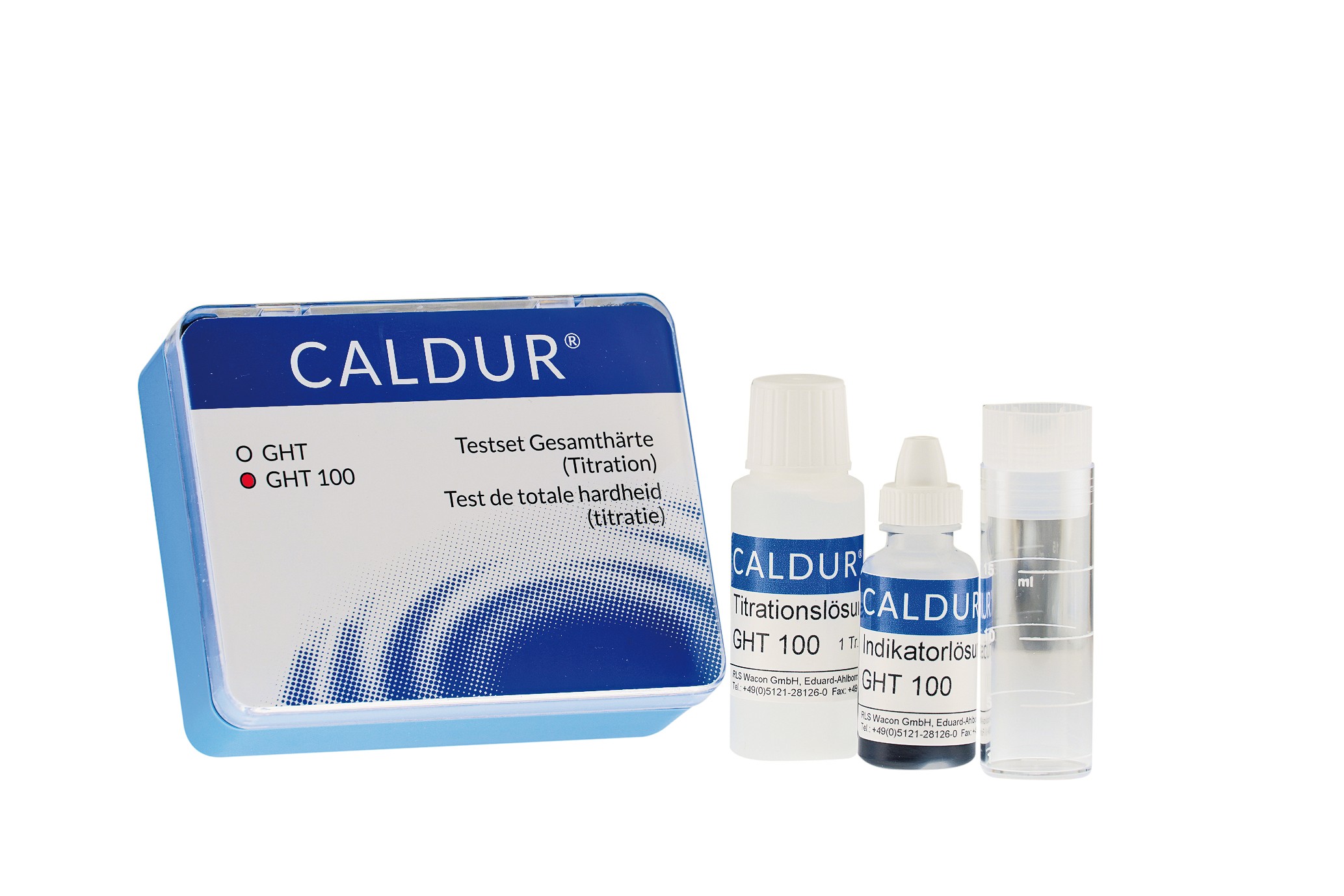
Caldur® Total hardness GHT 100 – Titration
Total hardness determination in water by titration (1.0 / 0.5 °dH per drop)

Private customers can also find our range in our partner store Ampha-Analyse.
Reagent for Caldur® Total hardness GHT 100 – Titration:
See also:
CALDUR® Total Hardness Test Set GHT 100 – Titration
What is the total hardness measured for?
The total hardness of water is an important parameter for water quality and describes the sum of all alkaline earth ions, mainly calcium (Ca²⁺) and magnesium (Mg²⁺). These ions originate from the natural dissolution of rocks and minerals and have a significant influence on the properties of the water.
In Germany, water hardness is given in °dH (degrees of German hardness):
- 0-7 °dH: Soft water
- 7-14 °dH: Medium hard water
- 14-21 °dH: Hard water
- >21 °dH: Very hard water
Knowing the water hardness is crucial for many applications: from the dosing of detergents and the adjustment of softening systems to the prevention of limescale deposits in pipes, boilers and industrial systems.
Hardness measurement is particularly important for: Drinking water treatment, boiler water monitoring, aquaristics, swimming pools, the food industry and industrial processes.
How does the test set work?
The CALDUR® Total Hardness Test Set GHT 100 uses the proven complexometric titration method with EDTA (ethylenediaminetetraacetic acid). In this method, the calcium and magnesium ions are bound by EDTA, with a Reagent indicating the end point by a characteristic color change.
Measuring principle: 2 reagents (Reagent and titration solution) are added to the water sample. When the titration solution is added drop by drop, the hardness constituents bind to the EDTA. The color change from red to green indicates that all hardness constituents are bound.
Calculation: Each drop of titration solution corresponds to 1.0 °dH (for 5 ml sample) or 0.5 °dH (for 10 ml sample). The number of drops multiplied by the drop value directly results in the total hardness in °dH.
Advantages of the CALDUR® test set
- Quick analysis in just 1 minute
Ideal for routine checks on site – immediate results without waiting time
- High precision due to drop-by-drop titration
Measured value per drop: 1.0 / 0.5 °dH – exact results thanks to proven complexometric method
- 100 at 10°dH Determinations per set
Economical for regular household, commercial and industrial checks
- Clear color change from red to green
Clear endpoint recognition – easy to read even for inexperienced users
- Flexible sample volume (5 ml or 10 ml)
Higher accuracy with 10 ml sample due to halved drop value
- Robust, waterproof plastic housing with hinged lid
Safe transportation and protection of reagents – durable even under harsh conditions
Areas of application
Carrying out the measurement:
- Fill water sample into test tubes up to the 5 ml or 10 ml mark
- Add a few drops of Reagent and mix by swirling gently
- Add titration solution drop by drop with constant swirling
- Count drops until the color clearly changes from red to green
- Calculate measured value: Number of drops × drop value = °dH
Tip for best results
For a clear color change, the water sample should be clear.
With a sample volume of 10 ml, you will obtain more accurate measured values (halved drop value).
The color change from red to green indicates the end of the titration.
A white background helps if the color change is difficult to see.
Important notes
- Bring reagents to room temperature before use
- Dispense drops evenly and vertically from the bottle
- Mix well after each drop and check for color change
- Rinse test tubes thoroughly with distilled water after use
- For red-green visual impairment: Use test set GH 100 red-blue (item no. 31-091310)
Measuring range
| Number of drops | Total hardness |
|---|---|
| 1 drop | 1.0 °dH (5 ml) / 0.5 °dH (10 ml) |
| 5 drops | 5.0 °dH (5 ml) / 2.5 °dH (10 ml) |
| 10 drops | 10.0 °dH (5 ml) / 5.0 °dH (10 ml) |
| 20 drops | 20.0 °dH (5 ml) / 10.0 °dH (10 ml) |
| 30 drops | 30.0 °dH (5 ml) / 15.0 °dH (10 ml) |
Calculation: Measured value (°dH) = number of drops × drop value
Number of possible provisions
With a CALDUR® test set total hardness GHT 100 you can test 100 at 10°dH.
This refers to the quantity of reagents contained.
Measuring accuracy and reproducibility
Readability: ± 1.0 (per drop for 5 ml sample)
Reproducibility: Very good if application instructions are followed and color perception is good
Interference: High concentrations of copper, zinc or iron can interfere with the measurement. Dilution is recommended for strongly colored samples.
Specifications at a glance
| Property | Value |
|---|---|
| Parameters | Total hardness (Ca²⁺ + Mg²⁺) |
| Item number | 31-071315 |
| Method | Titrimetric (complexometric) |
| Measuring principle | Drop counting until color change (red → green) |
| Measured value per drop | 1.0 / 0.5 °dH |
| Analysis duration | 1 minute |
| Number of determinations | 100 at 10°dH |
| Description | 2 reagents (Reagent and titration solution) |
| Packaging | Hinged lid box |
| Packaging size | 103 x 91 x 36 mm |
Scope of delivery
| Component | Component description |
|---|---|
| Reagent | 5 ml bottle with dropper insert |
| Titration solution | 30 ml bottle with dropper insert |
| 1 test tube | With 5 ml and 10 ml marking |
| Operating instructions | Detailed in DE/EN |
| Packaging | Robust hinged lid box (103 x 91 x 36 mm) |
Reagent details
| Reagent | Volume | Shelf life | Notes |
|---|---|---|---|
| Reagent | 5 ml | 24 months (24M) | Shake before use |
| Titration solution | 30 ml | 24 months (24M) | Dropper bottle, shake before use |
Shelf life: The shelf life starts from the date of manufacture (printed on the bottle).
After opening, the reagents should be used within 12 months.
Store the test kit in a dry, cool place (10-25°C) and away from direct sunlight.
Additional information
| Packaging | Hinged lid box, Reagent, Refill pack, Titration solution |
|---|---|
| Product category | Testset |
Flyer
Operating instructions
Instructions for use
Instructions for use
Similar articles:
Related products
-
 Total hardness determination in water by titration (0.5 / 0.25 °dH per drop)
 -
-


