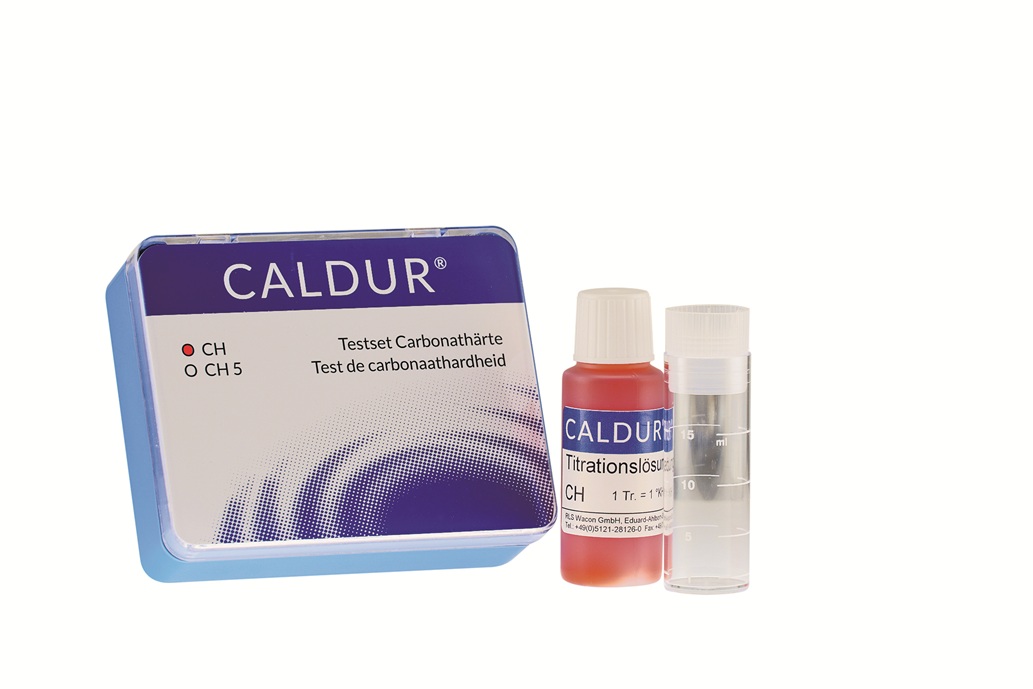
Caldur® Carbonate hardness CH – Titration
Determination of carbonate hardness in water by titration (0-20 °dH)

Private customers can also find our range in our partner store Ampha-Analyse.
Reagent for Caldur® Carbonate hardness CH – Titration:
See also:
CALDUR® Carbonate hardness CH test set – Titration
What is carbonate hardness measured for?
Carbonate hardness (temporary hardness) is an important parameter in water chemistry and provides information about the concentration of hydrogen carbonate and carbonate ions in the water. It is part of the total hardness and plays a decisive role in the buffering capacity of the water (pH stability).
Monitoring carbonate hardness is essential in boiler systems, as carbonate hardness precipitates and forms scale when heated. This impairs heat transfer and can lead to serious damage to the system. The carbonate hardness in boiler water should be as low as possible (< 0.5 °dH). In aquariums, carbonate hardness stabilizes the pH value and prevents dangerous pH fluctuations. A carbonate hardness of 3-10 °dH is optimal for most fish. Carbonate hardness also plays an important role for water quality in drinking water treatment and pool water.
How does the test set work?
The CALDUR® Carbonate hardness CH test set works according to the proven acid-base titration method. The hydrogen carbonate is neutralized by adding an acid solution drop by drop to a water sample with Reagent. The color changes at the equivalence point – the number of drops used corresponds directly to the carbonate hardness.
The method is simple, fast and provides reliable results in the measuring range from 0 to 20 °dH with a resolution of 1.0 °dH (0.5 °dH with half the sample quantity).
Advantages of the CALDUR® test set
- Quick analysis in just 1 minute
Ideal for daily checks in boiler systems and aquariums – immediate results
- Measuring range from 0 to 20 °dH with 1.0 °dH resolution
Covers all practice-relevant ranges, optional 0.5 °dH resolution possible
- 100 determinations at 10 °dH – economical in continuous use
Cost-efficient for regular inspections in waterworks and industrial plants
- Simple drop titration without aids
No additional devices required – direct reading
- Clear color change for precise results
Clearly recognizable end point of the titration
- Robust packaging format
Choice between hinged lid box and folding box
Areas of application
Carrying out the measurement:
- Fill water sample into test tubes up to the 10 ml mark (for 1.0 °dH resolution) or up to 20 ml (for 0.5 °dH resolution)
- Add titration solution drop by drop and shake well after each drop
- Count drops until the color changes from green to red/orange
- Number of drops = carbonate hardness in °dH (for 10 ml sample)
💡 Tip for best results
For best results, the water sample should be clear and free of suspended solids.
The color change from green to red/orange is clearly visible.
Shake well after each drop to ensure a complete reaction.
⚠️ Important notes
- Bring reagent to room temperature before use
- Shake thoroughly after each drop
- Do not miss the color change – view against a white background if necessary
- Rinse test tubes thoroughly with distilled water after use
Measuring range
| Measured value per drop | Sample quantity | Measuring range |
|---|---|---|
| 1.0 °dH | 10 ml | 0 to 20 °dH |
| 0.5 °dH | 20 ml | 0 to 10 °dH (higher resolution) |
For greater precision, you can work with a sample volume of 20 ml – each drop then corresponds to 0.5 °dH.
Number of possible provisions
With a CALDUR® Carbonate hardness CH test set you can carry out 100 measurements at 10 °dH.
With lower hardnesses, more measurements are possible.
Measuring accuracy and reproducibility
Resolution: 1.0 °dH (with 10 ml sample) or 0.5 °dH (with 20 ml sample)
Reproducibility: Very good if performed carefully
Interferences: No significant interferences for typical water samples
What to do if measured values are out of range?
Measured value > 20 °dH
| Dilution | Procedure | Calculation of the measured value |
|---|---|---|
| 1:1 | 5 ml sample + 5 ml distilled water | Number of drops × 2 = °dH |
| 1:4 | 2 ml sample + 8 ml distilled water | Number of drops × 5 = °dH |
Specifications at a glance
| Property | Value |
|---|---|
| Parameters | Carbonate hardness (CH) |
| Item number | 31-071420 |
| Method | Acid-base titration |
| Measuring principle | Droplet titration with color change |
| Measuring range | 0 to 20 °dH |
| Resolution | 1.0 °dH or 0.5 °dH |
| Analysis duration | 1 minute |
| Number of determinations | 100 at 10 °dH |
| Packaging | Hinged lid box or folding box |
| weight | approx. 120 g |
| Scope of delivery |
|---|
| 1 titration solution (30 ml) |
| 1 test tube with 10 ml / 20 ml scale |
| Detailed operating instructions (DE/EN) |
| Safety data sheets |
| Hinged lid box or folding box |
Reagent details
| Reagent | Volume | Shelf life | Notes |
|---|---|---|---|
| Titration solution | 30 ml | 24 months (24M) | Shake before use, already contains Reagent |
Shelf life: The shelf life starts from the date of manufacture (printed on the bottle).
After opening, the titration solution should be used within 12 months.
Store the test set in a dry, cool place (10-25°C) and away from direct sunlight.
Additional information
| Packaging | Folding box, Hinged lid box |
|---|---|
| Product category | Testset |
Flyer
Operating instructions
Instructions for use
Instructions for use
Similar articles:
Related products
-
![Caldur® Chlorine (free) - Colorimetric]() Chlorine (free) determination in water by color chart (0.05-1.0 mg/l Cl₂)
Chlorine (free) determination in water by color chart (0.05-1.0 mg/l Cl₂) -
![Caldur® Carbonate hardness CH 5 - Titration]() Determination of carbonate hardness in water by titration (0-10 °dH, high resolution)
Determination of carbonate hardness in water by titration (0-10 °dH, high resolution) -
![ammonium]() Determination of ammonium in water using a color chart (0.1-10 mg/l NH₄⁺)
Determination of ammonium in water using a color chart (0.1-10 mg/l NH₄⁺)


