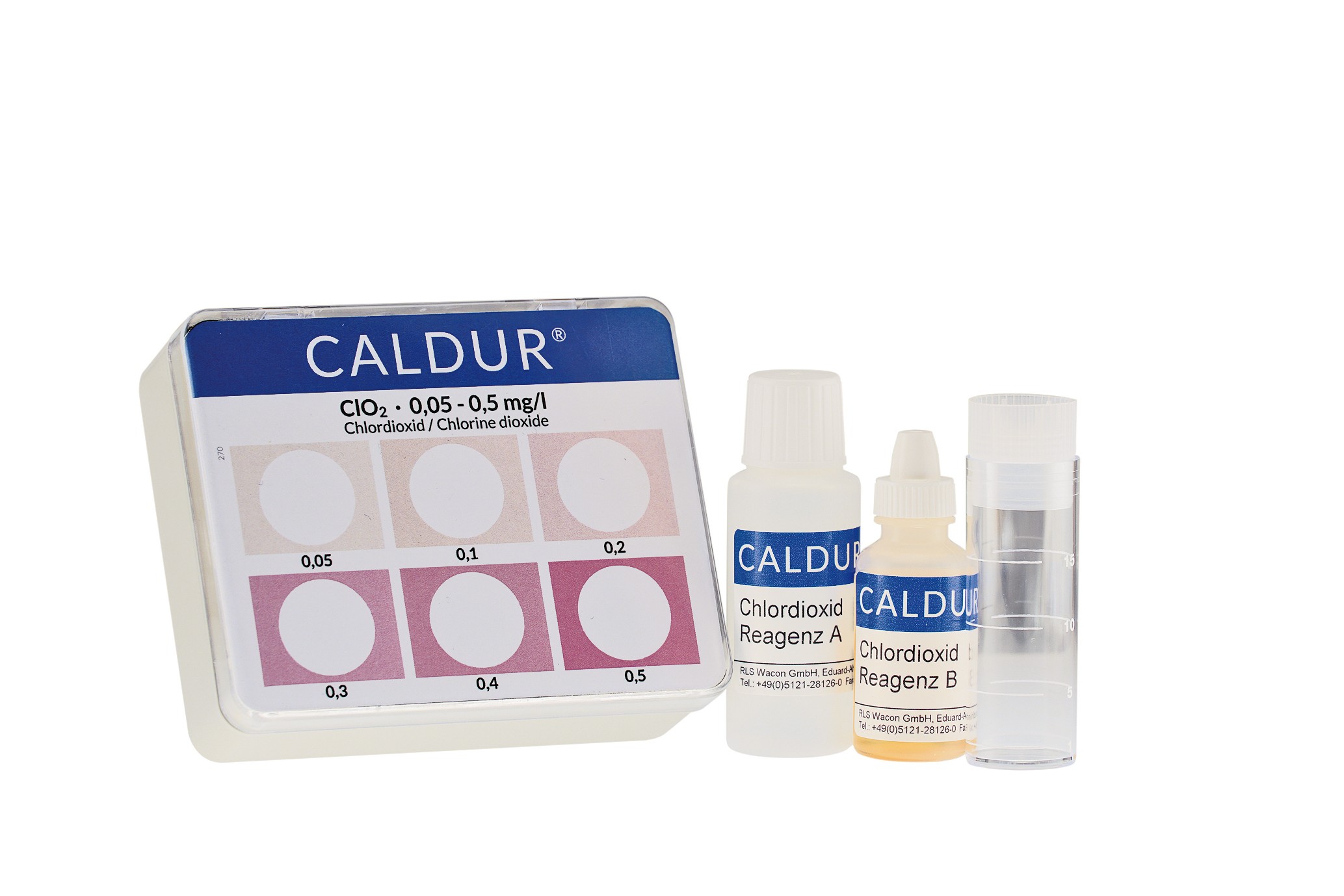
CALDUR® Chlorine dioxide – Titrimetric
Chlorine dioxide determination in water by titration with thiosulfate (2.5 mg/l ClO₂ per drop)
Article number:
depends on selection Categories Chlorine dioxide, Testsets CALDUR®, Titration method
Private customers can also find our range in our partner store Ampha-Analyse.
Reagent for CALDUR® Chlorine dioxide – Titrimetric:
See also:
CALDUR® Chlorine Dioxide Test Set – Titrimetric
What is chlorine dioxide measured for?
Chlorine dioxide (ClO₂) is a highly effective disinfectant that is increasingly being used in drinking water treatment and industrial cooling water systems. Unlike chlorine, chlorine dioxide does not form halogenated by-products such as trihalomethanes (THM) and is also effective at higher pH values.
The recommended range for chlorine dioxide in drinking water is 0.05-0.4 mg/l ClO₂ (DVGW W 624). However, significantly higher concentrations can occur during the production and dosing of chlorine dioxide, which must be monitored precisely.
This titrimetric test set is specially designed for monitoring higher concentrations. With a measured value of 2.5 mg/l ClO₂ per drop, it is ideal for checking dosing systems, monitoring chlorine dioxide production and quality assurance in water treatment.
How does the test set work?
The CALDUR® chlorine dioxide test kit works according to the titrimetric principle with thiosulphate. The water sample is first mixed with two indicator solutions. The titration solution is then added drop by drop until a characteristic color change indicates the end point.
Measuring principle: Chlorine dioxide oxidizes the added iodide to iodine, which is quantitatively determined by thiosulphate titration. Each drop of titration solution corresponds to 2.5 mg/l ClO₂.
Calculation: The number of drops used multiplied by 2.5 directly results in the chlorine dioxide concentration in mg/l.
Advantages of the CALDUR® test set
- Quantitative determination by titration
Precise measurement results for system control and quality control
- Measured value 2.5 mg/l ClO₂ per drop
Ideal for monitoring dosing systems and manufacturing processes
- 4 reagents for maximum accuracy
2 Reagents and 1 titration solution ensure reliable results
- Quick analysis in approx. 5 minutes
Efficient on-site determination without laboratory equipment
- 10 to 25 mg/l determinations per set
Economical for regular operational control
Areas of application
Carrying out the measurement:
- Fill the water sample into the test tube up to the mark
- Add Reagent 1 and mix
- Add Reagent 2 and mix
- Add titration solution drop by drop and mix after each drop
- Count drops until color change
- Calculation: Number of drops × 2.5 = mg/l ClO₂
Tip for best results
The sample should be analyzed as fresh as possible, as chlorine dioxide is more volatile than chlorine. Avoid direct sunlight during the measurement. Add the titration solution slowly and observe the color change closely.
Important notes
- Measure the sample immediately after taking it – chlorine dioxide is more volatile than chlorine
- Add reagents in the correct order
- Avoid direct sunlight during the measurement
- Thoroughly rinse the test tube with the sample before each measurement
Measuring range
| Property | Value |
|---|---|
| Measured value per drop | 2.5 mg/l ClO₂ |
| Measuring range | From 2.5 mg/l (by drop counting) |
Number of drops × 2.5 = chlorine dioxide concentration in mg/l.
Example: 4 drops × 2.5 = 10 mg/l ClO₂.
Number of possible destinations
With a CALDUR® Chlorine Dioxide Titrimetric Test Set you can carry out 10 to 25 measurements (depending on the concentration of the samples).
Measuring accuracy and reproducibility
Readability: ± 2.5 mg/l (per drop)
Reproducibility: Very good if the application instructions are followed
Interference: Chlorine and other oxidizing agents can increase the measured value. If chlorine is present at the same time, the test set measures the sum of all oxidizing agents.
Specifications at a glance
| Property | Value |
|---|---|
| Parameters | Chlorine dioxide (ClO₂) |
| Item number | 31-071610 |
| Method | Titrimetric (thiosulfate titration) |
| Measuring principle | Drop counting up to the color change |
| Measured value per drop | 2.5 mg/l ClO₂ |
| Duration of analysis | 5 minutes |
| Number of provisions | 10 to 25 |
| Reagents | 4 (2 Reagents, 1 titration solution) |
| Packaging | Hinged lid box |
| Packaging size | 103 x 91 x 36 mm |
Scope of delivery
| Reagent 1 | Dropper bottle (shelf life 24M) |
| Reagent 2 | Dropper bottle (shelf life 24M) |
| Titration solution | Dropper bottle (shelf life 24M) |
| Reagent 4 | Dropper bottle (shelf life 24M) |
| Test tubes | With markings |
| Operating instructions | DE/EN |
Additional information
| Packaging | Hinged lid box, Refill pack |
|---|---|
| Product category | Testset |
Flyer
Operating instructions
Similar articles:
Related products
-
 Determination of sulphide in water using a color chart (0.05-1.0 mg/l S²-)
-
-


