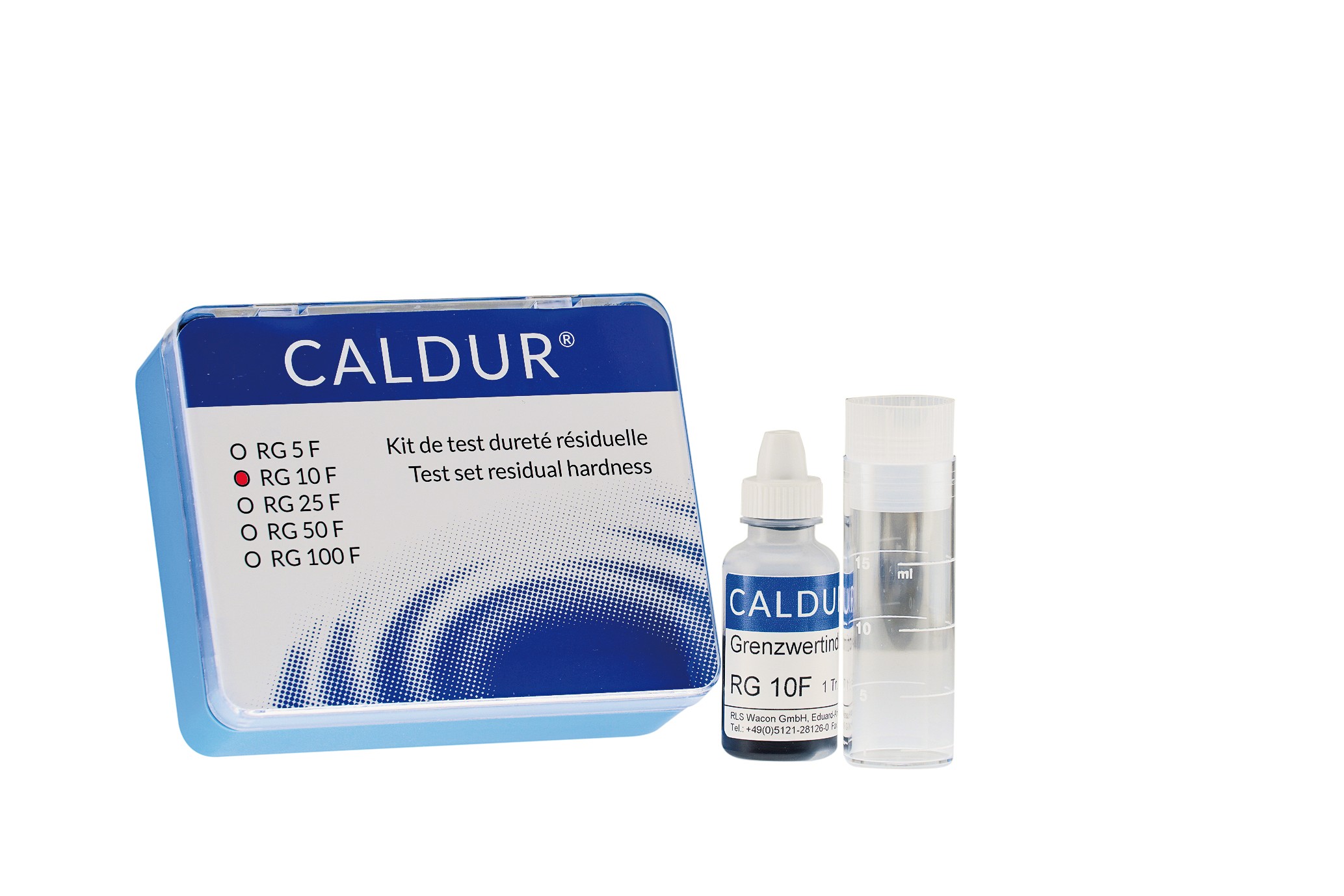
CALDUR® Residual hardness RG 10 F – Limit value
Residual hardness limit value determination in the water (limit value: 0.1 °fH)
Article number:
depends on selection Categories Limit value method, Testsets CALDUR®, Total hardness
Private customers can also find our range in our partner store Ampha-Analyse.
Reagent for CALDUR® Residual hardness RG 10 F – Limit value:
See also:
CALDUR® Residual hardness test set RG 10 F – limit value method (°fH)
What is residual hardness measured for?
Residual hardness is a decisive parameter when monitoring water softeners and
ion exchangers. After water softening, it must be ensured that the hardness formers
(calcium and magnesium) have been removed as far as possible in order to avoid limescale deposits in downstream
systems.
The RG 10 F test set tests for a limit value of 0.1 °fH (French degrees of hardness).
This limit value corresponds to approx. 0.056 °dH and is particularly relevant for international applications,
where the French hardness scale is used.
Regular monitoring of the residual hardness is essential in order to recognize the exhaustion status of the
ion exchanger in good time and to initiate regeneration before hard water
enters the system.
How does the test set work?
The CALDUR® residual hardness RG 10 F test set works according to the proven limit value method with a
color indicator. After adding a single drop of limit value indicator to the water sample,
the resulting color immediately indicates whether the residual hardness is above or below the limit value.
Green = residual hardness below 0.1 °fH – the water is sufficiently softened.
Red = residual hardness above 0.1 °fH – the ion exchanger must be regenerated.
This simple yes/no determination enables an extremely quick check without time-consuming
calculations or color comparisons.
Advantages of the CALDUR® test set
- Extremely fast analysis in just 1 minute
Immediate detection of whether the limit value is exceeded or not reached – ideal for frequent checks
- Easy handling – only 1 drop required
No drop counting, no calculation – color shows the result directly
- Limit value of 0.1 °fH (French degrees of hardness)
International scale for cross-border applications
- 250 provisions per set
Particularly economical for regular routine checks
- Clear color change green/red
Clear visual differentiation without room for interpretation
Areas of application
Carrying out the measurement:
- Fill water sample into test tube up to the 10 ml mark
- Add 1 drop of limit indicator RG 10
- Close the test tubes and mix well by swirling
- Assess the color of the solution (can be read off immediately)
- GREEN = residual hardness below limit value (≤ 0.1 °dH) – OK
- RED = residual hardness above limit value (> 0.1 °dH) – regeneration required
💡 Tip for best results
Carry out the measurement at room temperature (20-25°C).
If the water is very cold, color development may be somewhat slower.
For a clear color assessment, the sample should be clear and colorless.
If the color is uncertain, a comparative measurement with known softened water is recommended.
⚠️ Important notes
- Shake reagent well before use
- Only use 1 drop – more will distort the result
- With intermediate colors (orange/yellowish), the residual hardness is close to the limit value
- Rinse test tubes thoroughly with the sample before each measurement
- Strongly colored samples can make color assessment more difficult
- If the result is permanently red: regenerate the ion exchanger
Limit value
| Color after addition | Meaning | Measure |
|---|---|---|
| GREEN | Residual hardness ≤ 0.1 °fH | Water is sufficiently softened – no action required |
| RED | Residual hardness > 0.1 °fH | Regenerate ion exchanger or check softening system |
0.1 °fH corresponds to approx. 0.056 °dH or 1 mg/l CaCO₃.
1 °fH = 0.56 °dH = 10 mg/l CaCO₃
Number of possible provisions
You can carry out 250 measurements with a CALDUR® test set residual hardness RG 10 F.
Specifications at a glance
| Property | Value |
|---|---|
| Parameters | Residual hardness (Ca²⁺ + Mg²⁺) |
| Item number | 31-070234 / 31-070236 |
| Method | Limit value method (complexometric) |
| Limit value | 0.1 °fH |
| Analysis duration | 1 minute |
| Number of provisions | 250 |
| Description | 1 reagent, complexometric titration |
| Packaging | Hinged lid box / folding box |
Scope of delivery
| Limit indicator RG 10 F | 10 ml dropper bottle |
| 1 test tube | With 10 ml marking |
| Operating instructions | DE/EN/FR |
Additional information
| Packaging | Folding box, Hinged lid box |
|---|---|
| Product category | Testset |
Flyer
Operating instructions
Similar articles:
Related products
-
 Determination of sulphate in water by precipitation titration (20 mg/l SO₄²- per drop)
-
-


