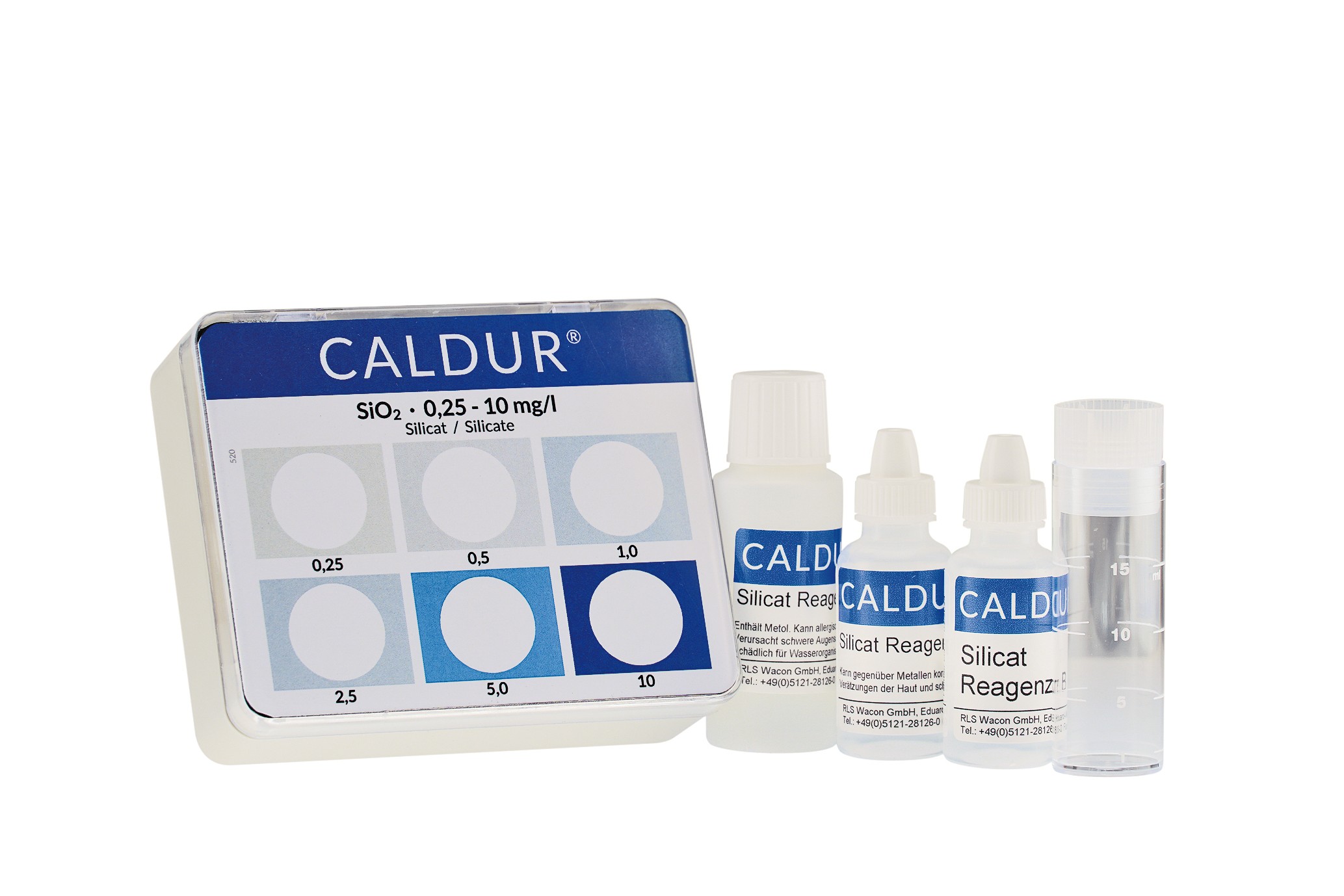
Caldur® Silicate – Colorimetric
Silicate determination in water using a color chart (0.25-10 mg/l SiO₂)

Private customers can also find our range in our partner store Ampha-Analyse.
Reagent for Caldur® Silicate – Colorimetric:
See also:
CALDUR® Silicate Test Set – Colorimetric
What is silicate measured for?
Silicate (SiO₂) enters the water naturally through the leaching of rocks and soils. Silicate control is particularly critical in boiler water and steam generator treatment: even low concentrations can lead to glass-like deposits on turbine blades and heat exchangers.
In cooling water systems, silicate in combination with calcium and magnesium promotes the formation of deposits that are difficult to dissolve. Regular checks help to avoid costly malfunctions.
Silicate plays a subordinate role in drinking water treatment, but can lead to blockages in membrane filtration processes (reverse osmosis) if the concentration is too high.
How does the test set work?
The CALDUR® silicate test set is based on the silicomolybdate blue method. Silicate reacts with molybdate in an acidic solution to form yellow silicomolybdate, which is then reduced to a blue complex. The blue coloration is proportional to the silicate concentration.
The measured value is determined by direct color comparison with a 6-stage color chart supplied.
Advantages of the CALDUR® test set
- Measuring range 0.25 – 10 mg/l SiO₂
Covers the practical range for boiler water and industry
- 100 provisions per set
Economical for regular checks
- Quick analysis in just 1 minute
Immediate results on site
- Easy handling with 3 reagents
No measuring devices required
- Robust plastic housing with hinged lid
Safe transportation and protection of reagents
Areas of application
Carrying out the measurement:
- Fill water sample into test tube up to the 10 ml mark
- Add 3 drops of reagent A and mix
- Add 3 drops of reagent B and mix
- Add 3 drops of reagent C and mix
- Wait for 1 minute reaction time
- Perform color comparison with color chart
Tip for best results
For best results, the water sample should be clear and free of suspended solids.
If the water is cloudy, pre-filtration with a filter paper is recommended.
Reagent C (oxalic acid) must be added as it suppresses phosphate interference.
Important notes
- Bring reagents to room temperature before use (20-25 °C)
- Observe the order in which the reagents are added (A → B → C)
- Never omit reagent C – it eliminates phosphate interferences
- Avoid direct sunlight during the measurement
- Rinse test tubes thoroughly with the sample before each measurement
- Do not use glass containers – glass releases silicate!
Measuring range
| Measuring level | Description |
|---|---|
| 0.25 mg/l | Very low concentration (weak blue) |
| 0.5 mg/l | Low concentration (light blue) |
| 1.0 mg/l | Slightly increased concentration (blue) |
| 2.0 mg/l | Medium concentration (strong blue) |
| 5.0 mg/l | High concentration (dark blue) |
| 10.0 mg/l | Very high concentration (deep blue) |
If the color is between two fields, you can form the mean value
(e.g. between 1.0 and 2.0 mg/l = approx. 1.5 mg/l).
Number of possible provisions
You can carry out 100 measurements with one CALDUR® silicate test kit.
This refers to the quantity of reagents contained.
Measuring accuracy and reproducibility
Readability: ± 1 color level
Reproducibility: Very good if the application instructions are followed
Interference: Phosphate in high concentrations (> 50 mg/l) can slightly increase the measured value. The addition of reagent C (oxalic acid) suppresses the phosphate interference.
What to do if measured values are out of range?
Measured value > 10 mg/l
| Dilution | Procedure | Calculation of the measured value |
|---|---|---|
| 1:4 | 2 ml sample + 8 ml silicate-free water | Measured value × 5 |
| 1:9 | 1 ml sample + 9 ml silicate-free water | Measured value × 10 |
Measured value < 0.25 mg/l
measured value is below the detection limit of this test kit. This is generally not critical.
Specifications at a glance
| Property | Value |
|---|---|
| Parameters | Silicate (SiO₂) |
| Item number | 31-072520 |
| Method | Colorimetric (silicomolybdate blue) |
| Measuring principle | Color comparison with 6-stage color chart |
| Measuring range | 0.25 to 10 mg/l SiO₂ |
| Color scale | 6 measuring levels (0.25 / 0.5 / 1.0 / 2.0 / 5.0 / 10.0 mg/l) |
| Analysis duration | 1 minute |
| Number of provisions | 100 |
| Number of reagents | 3 |
| Packaging | Hinged lid box |
| Packaging size | 103 x 91 x 36 mm |
| weight | approx. 170 g |
| Scope of delivery |
|---|
| 3 reagent bottles (reagent A, B, C) with detailed labeling |
| 1 test tube with 10 ml scale |
| 1 color card with 6 measuring levels |
| Detailed operating instructions (DE/EN) |
| Safety data sheets for all reagents |
| Robust hinged lid box (103 x 91 x 36 mm) |
Reagent details
| Reagent | Volume | Shelf life | Notes |
|---|---|---|---|
| Reagent A (molybdate) | 15 ml | 24 months (24M) | Shake before use |
| Reagent B (reducing agent) | 15 ml | 24 months (24M) | Shake before use |
| Reagent C (oxalic acid) | 15 ml | 24 months (24M) | Suppresses phosphate interference |
Shelf life: The shelf life starts from the date of manufacture (printed on the bottle).
After opening, the reagents should be used within 12 months.
Store the test kit in a dry, cool place (10-25 °C) and away from direct sunlight.
Additional information
| Packaging | Hinged lid box, Refill pack |
|---|---|
| Product category | Testset |
Flyer
Operating instructions
Similar articles:
Related products
-
 pH determination in the neutral range using a color chart (pH 5-8)
 -
-


