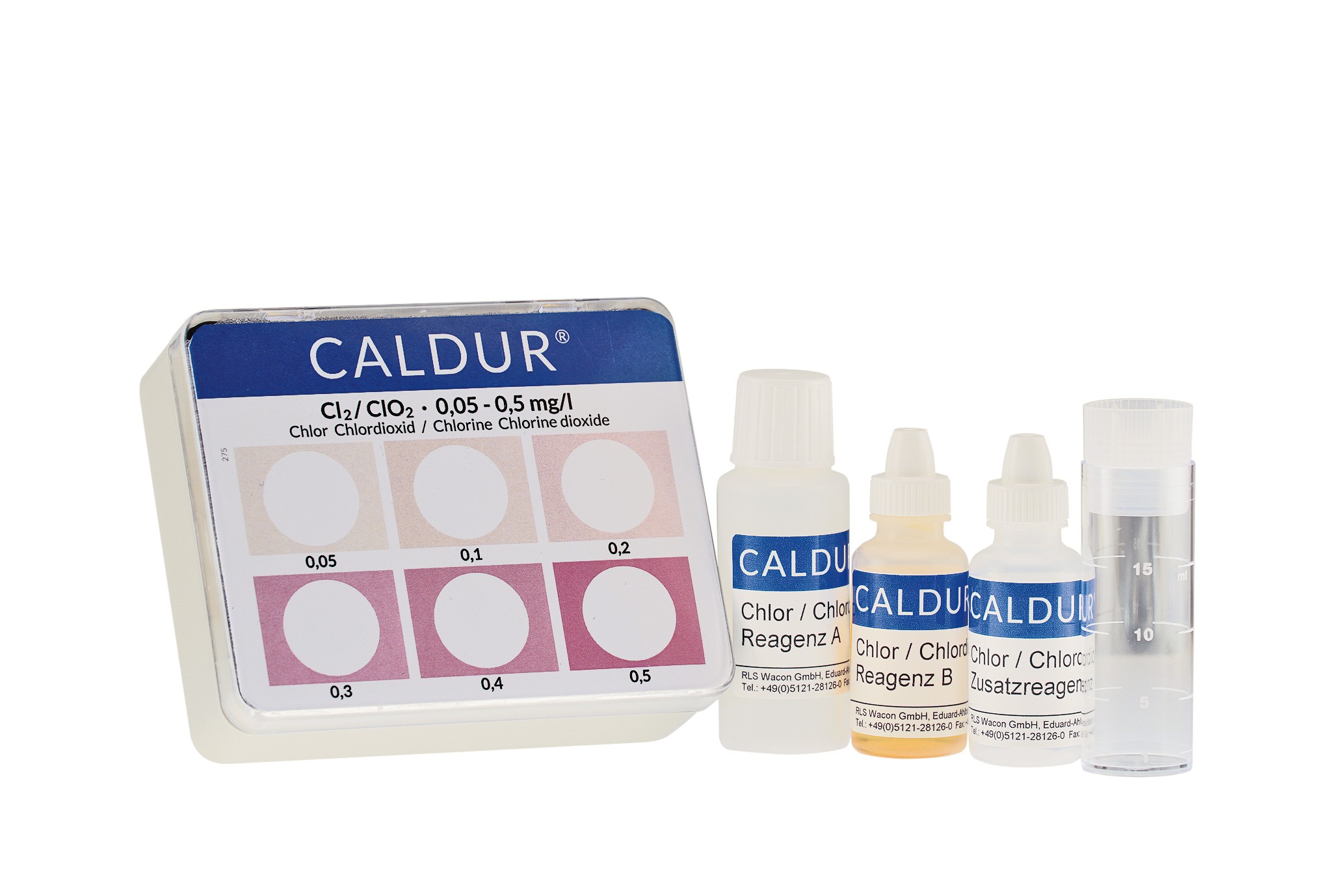
CALDUR® Chlorine/chlorine dioxide – Colorimetric
Chlorine/chlorine dioxide combination determination in water using a color chart (0.05-0.5 mg/l Cl₂/ClO₂)

Private customers can also find our range in our partner store Ampha-Analyse.
Reagent for CALDUR® Chlorine/chlorine dioxide – Colorimetric:
See also:
CALDUR® Chlorine/Chlorine Dioxide Test Set – Colorimetric
What is chlorine/chlorine dioxide measured for?
This combination test kit enables the simultaneous determination of chlorine dioxide and chlorine in a single measurement. Chlorine dioxide (ClO₂) is increasingly being used as a disinfectant in drinking water treatment as, unlike chlorine, it does not form any halogenated by-products.
In many systems, chlorine dioxide and chlorine are used in combination to ensure comprehensive disinfection. This test set detects both substances and enables a differentiated assessment of the disinfection effect.
Regular monitoring of both parameters is particularly important in drinking water supplies, in cooling water systems and in the food industry.
How does the test set work?
The CALDUR® chlorine/chlorine dioxide test set works according to the DPD method. By using three reagents, both chlorine dioxide and chlorine can be detected. The color intensity is compared with the 6-stage color chart.
Advantages of the CALDUR® test set
- Combination test kit for chlorine dioxide AND chlorine
Two parameters in one test set – efficient and cost-effective
- Quick analysis in just 1 minute
Immediate results on site
- 150 determinations per set
Economical for regular checks
- Proven DPD method
Reliable and reproducible results
Areas of application
Carrying out the measurement:
Measurement 1: Chlorine dioxide (ClO₂)
- Fill water sample into test tubes up to the 10 ml mark
- Add 5 drops of reagent A and mix
- Perform color comparison with color chart immediately → Measured value 1 (= ClO₂)
Measurement 2: Chlorine dioxide + chlorine (total)
- Add 3 drops of reagent B to the same sample and mix
- Wait 1 minute
- Perform color comparison with color chart → measured value 2 (= ClO₂ + chlorine)
Calculation:
Chlorine dioxide = measured value 1
Free chlorine = measured value 2 – measured value 1
Tip for best results
Measurement 1 (ClO₂) must be read immediately after the addition of reagent A, as chlorine only reacts with DPD after a longer reaction time. This ensures a clean separation between chlorine dioxide and chlorine.
Reagent C (glycine) can optionally be used to mask chlorine if a particularly precise ClO₂ determination is required.
Important notes
- Measure the sample immediately after taking it – chlorine dioxide is more volatile than chlorine
- Read off measurement 1 immediately (before reagent B) – otherwise chlorine will falsify the ClO₂ result
- Avoid direct sunlight during the measurement
- If the color fades: dilute the sample and measure again
- Thoroughly rinse the test tube with the sample before each measurement
Measuring range
| Measuring level | Description |
|---|---|
| 0.05 mg/l | Very low concentration (pale pink) |
| 0.1 mg/l | Low concentration (light pink) |
| 0.15 mg/l | Slightly increased concentration (pink) |
| 0.2 mg/l | Medium concentration (deep pink) |
| 0.3 mg/l | Increased concentration (pink-violet) |
| 0.5 mg/l | High concentration (violet) |
If the color lies between two fields, you can form the mean value
(e.g. between 0.1 and 0.15 mg/l = approx. 0.12 mg/l).
Number of possible determinations
With a CALDUR® test set chlorine/chlorine dioxide you can carry out 150 measurements.
This refers to the quantity of reagents contained.
Measuring accuracy and reproducibility
Readability: ± 1 color level
Reproducibility: Very good if the application instructions are followed
Interference: Bromine and ozone also react with DPD and can increase the measured value. Manganese(VII) can interfere at high concentrations. A photometric determination is recommended for samples with known interferences.
What to do if measured values are out of range?
Measured value > 0.5 mg/l
| Dilution | Execution | Calculation of the measured value |
|---|---|---|
| 1:1 | 5 ml sample + 5 ml chlorine-free water | Measured value × 2 |
| 1:4 | 2 ml sample + 8 ml chlorine-free water | Measured value × 5 |
Measured value < 0.05 mg/l
Measured value is below the detection limit. When disinfecting drinking water with chlorine dioxide, a minimum concentration of 0.05 mg/l ClO₂ should be present at the tap (DVGW W 624).
Specifications at a glance
| Property | Value |
|---|---|
| Parameters | Chlorine/chlorine dioxide (Cl₂/ClO₂) |
| Item number | 31-072275 |
| Method | Colorimetric (DPD) |
| Measuring principle | Color comparison with 6-stage color chart |
| Measuring range | 0.05 to 0.5 mg/l Cl₂/ClO₂ |
| Color scale | 6 measuring levels (0.05 / 0.1 / 0.15 / 0.2 / 0.3 / 0.5 mg/l) |
| Analysis duration | 1 minute |
| Number of determinations | 150 |
| Number of reagents | 3 |
| Packaging | Hinged lid box |
| Packaging size | 103 x 91 x 36 mm |
| weight | approx. 170 g |
| Scope of delivery |
|---|
| 3 reagent bottles (reagent A, reagent B, reagent C) with detailed labeling |
| 1 test tube with 10 ml scale |
| 1 color card with 6 measuring levels |
| Detailed operating instructions (DE/EN) |
| Safety data sheets for all reagents |
| Robust hinged lid box (103 x 91 x 36 mm) |
Reagent details
| Reagent | Volume | Shelf life | Notes |
|---|---|---|---|
| Reagent A (DPD 1) | 30 ml | 24 months (24M) | DPD reagent, shake before use |
| Reagent B (buffer) | 10 ml | 24 months (24M) | Buffer solution, shake before use |
| Reagent C (glycine) | 10 ml | 24 months (24M) | For differentiation chlorine/ClO₂ |
Shelf life: The shelf life starts from the date of manufacture (printed on the bottle).
After opening, the reagents should be used within 12 months.
Store the test kit in a dry, cool place (10-25°C) and protected from direct sunlight.
Additional information
| Packaging | Hinged lid box, Refill pack |
|---|---|
| Product category | Test kit |
Flyer
Operating instructions
Similar articles:
Related products
-
 Determination of ammonium in water using a color chart (0.1-10 mg/l NH₄⁺)
-
-


