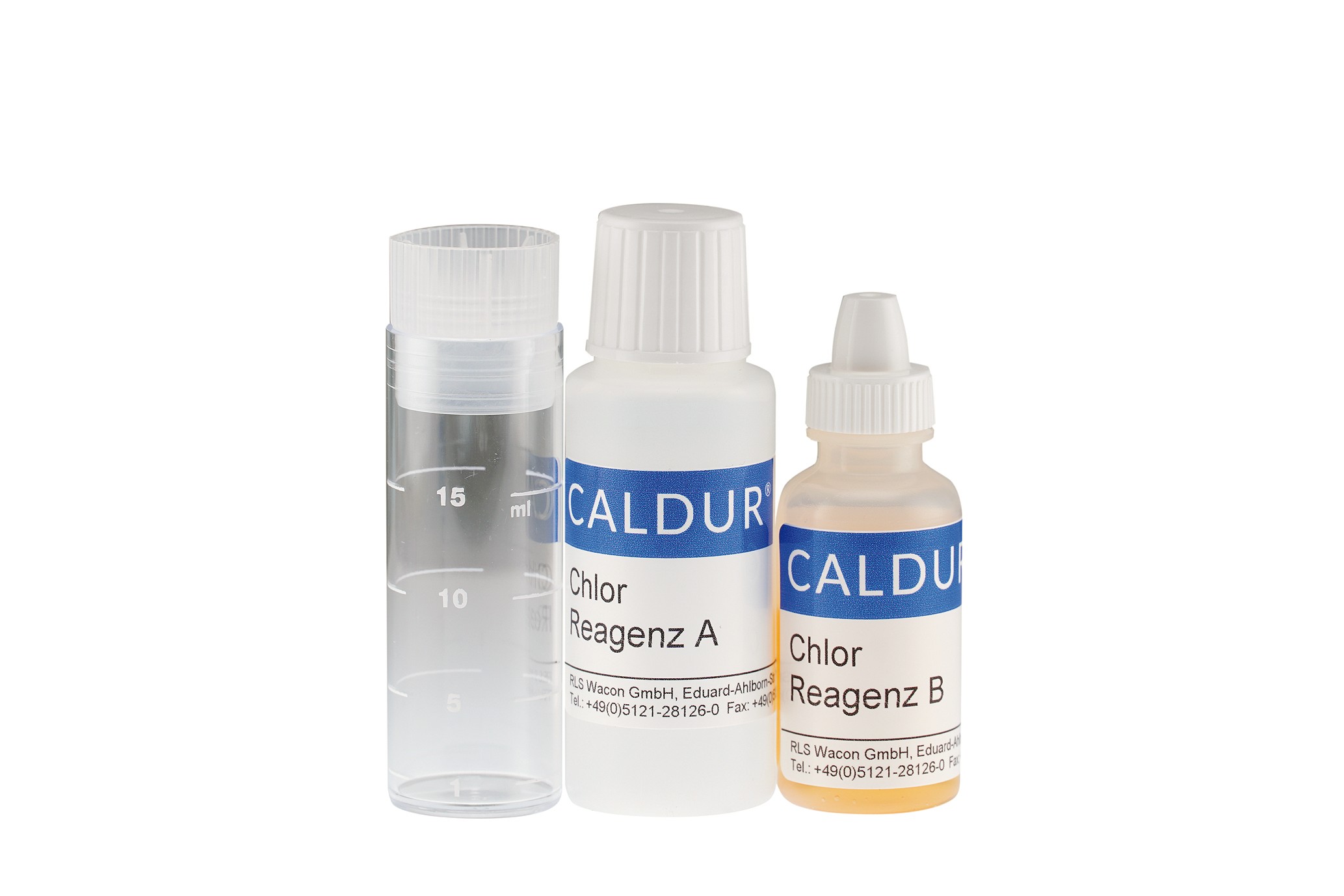
Caldur® Chlorine (free) – Photometric
Chlorine (free) determination in water using a photometer (0.05-1.0 mg/l Cl₂)

Private customers can also find our range in our partner store Ampha-Analyse.
Reagent for Caldur® Chlorine (free) – Photometric:
See also:

CALDUR® Chlorine (free) test kit – Photometric
What is free chlorine measured for?
Free chlorine is the most commonly used disinfectant in the world for treating drinking water and swimming pool water. It reliably kills bacteria, viruses and other pathogens, thus ensuring hygienically safe water. In chlorination, free chlorine is the active, disinfecting form that is responsible for effective water disinfection.
Free chlorine in drinking water should be between 0.1 and 0.3 mg/l to ensure a sufficient disinfection effect. Higher concentrations are recommended in swimming pools, depending on use. Regular monitoring of the free chlorine content is essential for ensuring water quality and protecting health.
Limit values according to the Drinking Water Ordinance:
– Free chlorine: max. 0.3 mg/l Cl₂
Regular measurement of free chlorine is essential for effective disinfection. The CALDUR® Chlorine (free) Test Set – Photometric enables the precise determination of free chlorine with the WINLAB Data Line photometer for maximum measurement accuracy.
How does the test set work?
The CALDUR® Chlorine (free) test set is based on the proven DPD method (N,N-diethyl-p-phenylenediamine). DPD reacts specifically with free chlorine to form a pink-violet dye, the intensity of which is proportional to the chlorine concentration.
Measurement of free chlorine: After adding the reagents, a pink coloration corresponding to the free chlorine content develops immediately. The evaluation is carried out photometrically with the WINLAB Data Line photometer for objective and reproducible measurement results.
The DPD method is internationally recognized and complies with the DIN EN ISO 7393-2 standards and WHO recommendations. The photometric evaluation allows you to achieve maximum precision and documentable measurement results – ideal for professional applications in the laboratory and in industry.
Advantages of the CALDUR® test set
- Quick analysis in just 1 minute
Immediate results for free chlorine – ideal for daily routine checks
- Photometric measurement for maximum precision
Objective and reproducible measurement results with the WINLAB Data Line Photometer
- Low measuring range 0.05 – 1.0 mg/l Cl₂
Perfect for drinking water monitoring and monitoring limit values
- 150 provisions per set – economical in continuous use
Cost-efficient for daily checks in waterworks, swimming pools and industry
- DPD method according to international standards
Standard-compliant according to DIN EN ISO 7393-2 – globally recognized reference method
- Compact packaging in a plastic bag
Space-saving and ideal for use with existing equipment
Areas of application
Carrying out the measurement:
Measurement of free chlorine:
- Fill the water sample into the cuvette up to the 10 ml mark
- Add 5 drops of reagent A and mix
- Insert the cuvette into the WINLAB Data Line photometer
- Start measurement and read off result (within 1 minute)
Tip for best results
The measurement should be carried out immediately after sampling, as chlorine is volatile.
Avoid exposure to sunlight and do not heat the sample.
At high chlorine concentrations, the color may fade again after the maximum (bleaching) – in this case, dilute the sample.
Important notes
- Measure the sample immediately after taking it – chlorine volatilizes quickly
- Do not exceed the reaction time for free chlorine (max. 1 minute)
- Avoid direct sunlight during the measurement
- If the color fades: Dilute the sample and measure again
- Rinse the cuvette thoroughly with the sample before each measurement
Measuring range
| Measuring level | Description |
|---|---|
| 0.05 mg/l | Very low concentration |
| 0.1 mg/l | Low concentration |
| 0.25 mg/l | Normal drinking water concentration |
| 0.5 mg/l | Elevated concentration |
| 0.75 mg/l | High concentration |
| 1.0 mg/l | Very high concentration |
The WINLAB Data Line photometer enables continuous measurement over the entire range.
Intermediate values are automatically calculated and displayed.
Number of possible provisions
You can carry out 150 measurements with a CALDUR® Chlorine test set (free).
This refers to the quantity of reagents contained.
Measuring accuracy and reproducibility
Photometric accuracy: ± 3% of the measured value
Reproducibility: Very good if the application instructions are followed
Interference: High concentrations of manganese or chromium can influence the result. Ozone and bromine also react with DPD.
What to do if measured values are out of range?
Measured value > 1.0 mg/l
| Dilution | Procedure | Calculation of the measured value |
|---|---|---|
| 1:1 | 5 ml sample + 5 ml chlorine-free water | Measured value × 2 |
| 1:4 | 2 ml sample + 8 ml chlorine-free water | Measured value × 5 |
Measured value < 0.05 mg/l
Measured value is below the detection limit. A minimum concentration of 0.1 mg/l free chlorine should be present in drinking water to ensure disinfection.
Specifications at a glance
Reagents (2 reagents)
| Property | Value |
|---|---|
| Parameters | Chlorine – free (Cl₂) |
| Item number | 31-073242 |
| Method | Photometric (DPD) |
| Measuring principle | Photometric measurement with WINLAB Data Line Photometer |
| Measuring range | 0.05 to 1.0 mg/l Cl₂ |
| Analysis duration | 1 minute |
| Number of provisions | 150 |
| Number of reagents | 2 |
| Packaging | Plastic bag or refill pack |
| weight | approx. 100 g |
| Scope of delivery |
|---|
| 2 reagent bottles (reagent A, reagent B) with detailed labeling |
| Detailed operating instructions (DE/EN) |
| Safety data sheets for all reagents |
| Packaging: plastic bag or refill pack |
Reagent details
| Reagent | Volume | Shelf life | Notes |
|---|---|---|---|
| Reagent A | 30 ml | 24 months (24M) | For free chlorine, shake before use |
| Reagent B | 10 ml | 24 months (24M) | Buffer, shake before use |
Shelf life: The shelf life starts from the date of manufacture (printed on the bottle).
After opening, the reagents should be used within 12 months.
Store the test kit in a dry, cool place (10-25°C) and away from direct sunlight.
Additional information
| Packaging | Plastic bag, Refill pack |
|---|---|
| Product category | Testset |
Flyer
Operating instructions
Instructions for use
Instructions for use
Similar articles:
Related products
-
 pH determination in the neutral range using a color chart (pH 5-8)
 -
-


