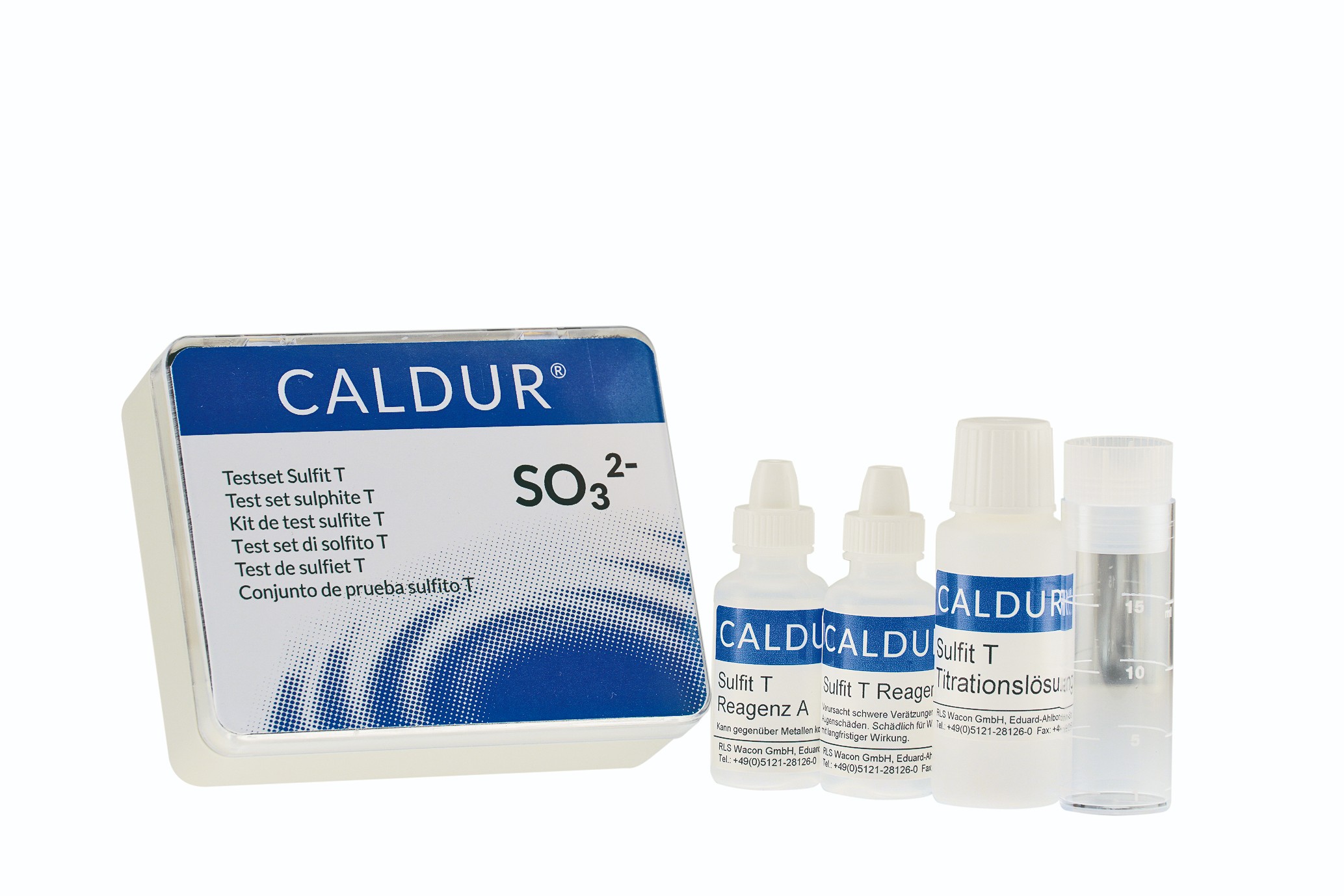
CALDUR® Sulfite T – Titrimetric
Sulfite determination in water by titration (5 mg/l SO₃²⁻ per drop)

Private customers can also find our range in our partner store Ampha-Analyse.
Reagent for CALDUR® Sulfite T – Titrimetric:
See also:
CALDUR® Sulfite Test Set T – Titrimetric
What is sulfite measured for?
Sulfite (SO₃²⁻) is used in water treatment as an oxygen scavenger to prevent corrosion in steam boilers, heating systems and closed cooling systems. As a reducing agent, sulfite reacts with dissolved oxygen and thus protects pipes and plant components from oxygen corrosion.
The optimal sulfite concentration in boiler water is 20-30 mg/l SO₃²⁻. Regular monitoring is essential, as values that are too low do not provide sufficient corrosion protection, while concentrations that are too high are uneconomical and promote the formation of sulfate.
In the food industry, sulfite is also used as a preservative and antioxidant. Monitoring the sulfite concentration is therefore of great importance in various industrial sectors.
How does the test set work?
The CALDUR® Sulfite Test Set T works according to the proven iodometric titration method. After preparing the water sample with two reagents, a titration solution is added drop by drop until a clear colour change occurs.
The measured value results from the number of drops used – each drop corresponds to 5 mg/l SO₃²⁻. This method is particularly fast (just 1 minute) and is excellently suited for routine monitoring in boiler plants.
Benefits of the CALDUR® test set
- Very fast analysis in just 1 minute
Fastest CALDUR® method for sulfite – ideal for frequent checks in shift operation
- Simple drop counting without complex evaluation
Each drop = 5 mg/l – very easy calculation directly on site
- Precise titration method based on the iodometric principle
Proven procedure with high reproducibility and reliability
- 100 determinations per set
Sufficient for regular checks in boiler plants and heating stations
- Flexible measuring range through drop counting
From 5 mg/l to over 100 mg/l – measurable by simply continuing to add drops
- No special instruments required
Just a dropper bottle and test tube – perfect for mobile use
- Robust, waterproof plastic housing with hinged lid
Safe transport and protection of the reagents – durable even under harsh conditions
Application areas
Carrying out the measurement:
- Fill the water sample into the test tube up to the 10 ml mark
- Add reagent A and mix well by carefully swirling
- Add reagent B and mix again
- Add the titration solution drop by drop while swirling continuously
- Count the drops until a clear colour change (colourless → bluish)
- Calculate the value: number of drops × 5 = mg/l SO₃²⁻
💡 Tip for best results
For a clear colour change, the water sample should be clear.
Add the titration solution slowly and while swirling continuously.
The colour change from colourless to bluish indicates the end of the titration.
The measurement should be carried out as soon as possible after sampling, as sulfite oxidises in air.
⚠️ Important notes
- Bring reagents to room temperature before use
- Protect the sample from air contact (sulfite oxidises quickly)
- Count the drops exactly – each drop counts 5 mg/l!
- For boiler water: let the sample cool down or use a sample cooler
- Store the titration solution protected from light
- After use, rinse the test tube thoroughly with distilled water
- In case of an unclear colour change: filter or dilute the sample
Measuring range
| Number of drops | Sulfite concentration | Assessment |
|---|---|---|
| 1 drop | 5 mg/l | Very low (insufficient for boiler water) |
| 2 drops | 10 mg/l | Low (too low for boiler water) |
| 4 drops | 20 mg/l | Optimal for boiler water (target range) |
| 6 drops | 30 mg/l | Optimal for boiler water (upper range) |
| 8 drops | 40 mg/l | Elevated (still acceptable) |
| 10 drops | 50 mg/l | High (overdosing) |
| 20 drops | 100 mg/l | Very high (clear overdosing) |
Measured value (mg/l) = number of drops × 5 mg/l
Example: 6 drops = 6 × 5 = 30 mg/l SO₃²⁻
Number of possible determinations
With one CALDUR® Sulfite T test set you can carry out 100 measurements.
This refers to the quantity of reagents and titration solution included.
Measuring accuracy and reproducibility
Readability: ± 5 mg/l (per drop)
Reproducibility: Very good when the application instructions are followed and colour perception is good
Interferences: Turbidity of the sample can make the colour change harder to see (filter the sample if necessary). High concentrations of sulfide and thiosulfate can interfere with the measurement.
What to do with values outside the range?
Very high consumption (> 20 drops)
For very high sulfite concentrations you can dilute the sample:
| Dilution | Procedure | Calculation of the value |
|---|---|---|
| 1:1 | 5 ml sample + 5 ml distilled water | (number of drops × 5) × 2 |
| 1:4 | 2 ml sample + 8 ml distilled water | (number of drops × 5) × 5 |
No colour change after many drops
If no colour change occurs after 20+ drops, the sulfite concentration is outside the practical measuring range. Carry out a dilution or use a photometric method.
Specifications at a glance
| Property | Value |
|---|---|
| Parameter | Sulfite (SO₃²⁻) |
| Article number | 31-071585 |
| Method | Titrimetric (iodometric) |
| Measuring principle | Drop counting until colour change (1 drop = 5 mg/l) |
| Measuring range | 5 mg/l per drop (flexibly extendable) |
| Typical range | 5 to 100 mg/l SO₃²⁻ |
| Analysis time | 1 minute |
| Number of determinations | 100 |
| Packaging | Hinged-lid box |
| Packaging size | 103 x 91 x 36 mm |
| Weight | approx. 180 g |
Scope of delivery
| Component | Description |
|---|---|
| 3 reagent bottles | Reagent A, reagent B and titration solution with detailed labelling |
| 1 test tube | With 10 ml scale |
| Operating instructions | Detailed in DE/EN with titration guide |
| Safety data sheets | For all reagents |
| Packaging | Robust hinged-lid box (103 x 91 x 36 mm) |
Reagent details
| Reagent | Volume | Shelf life | Notes |
|---|---|---|---|
| Reagent A (Sulfite T) | 10 ml | 24 months (24M) | Shake before use |
| Reagent B (Sulfite T) | 7.5 ml | 24 months (24M) | Shake before use |
| Titration solution | 30 ml | 24 months (24M) | Dropper bottle, shake before use |
Shelf life: The shelf life starts from the date of manufacture (printed on the bottle).
After opening, the reagents should be used within 12 months.
Store the test set in a dry, cool place (10-25°C) and protected from direct sunlight.
Additional information
| Packaging | Scharnierdeckelkasten, Nachfüllpack, Nachfüllpack Reagenz A+B, Nachfüllpack Titrationslösung |
|---|---|
| Product category | Testset |
Flyer
Operating instructions

Similar articles:
Related products
-
 Residual hardness limit value determination in the water (limit value: 1.0 °dH)
-
-


