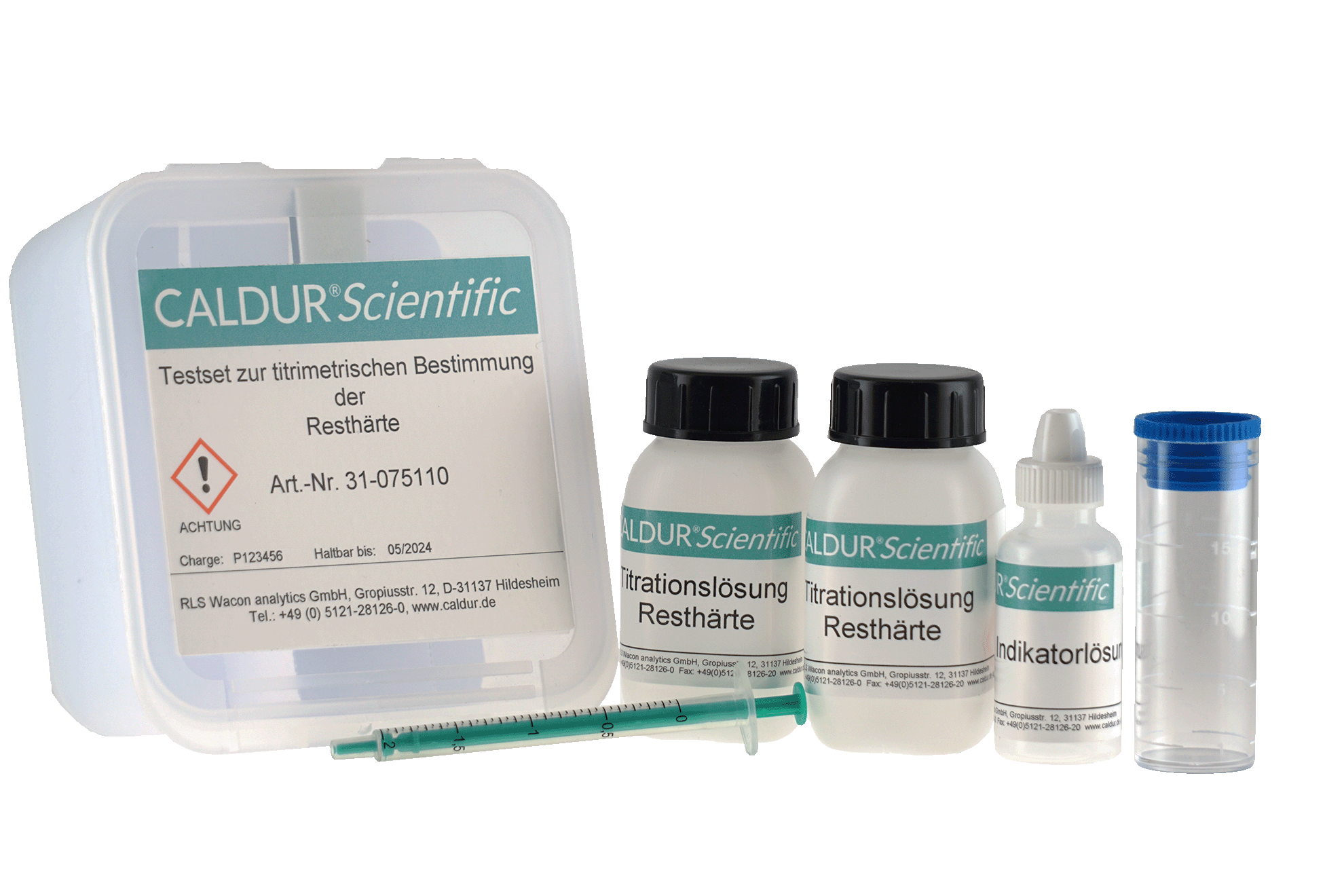
CALDUR® Residual Hardness Scientific Test Set – Syringe titration
What is residual hardness measured for?
The residual hardness is the degree of hardness remaining after water treatment (e.g. softening, ion exchange). It is an important control parameter for the function of water softeners and water treatment systems.
This test set is available in three units:
- 0 – 2 °dH (German hardness) – standard in Germany
- 0 – 2 °fH (French hardness)
- 0 – 20 ppm CaCO₃ – International unit
The Scientific series from CALDUR® offers maximum precision for low hardness ranges thanks to innovative syringe titration. Intermediate values can be read directly from the scale.
How does the test set work?
The CALDUR® Residual Hardness Scientific test set uses a precise dosing syringe for titration. Two reagents are added to the water sample, then the titration solution is added using the syringe. The measured value is read directly from the syringe scale – no drop counting required!
Advantages of the CALDUR® test set
- Quick analysis in just 1 minute
Ideal for regular checks of softening systems
- Highest precision through syringe titration
Stepless reading enables intermediate values – no drop counting required
- Three units available
°dH, °fH or ppm – choose the right unit for your application
- Approx. 200 determinations per set
Particularly economical due to high number of possible measurements
- Optimized for low hardness ranges
Specially designed for the control of treated water
Measuring range
| Unit |
Measuring range |
Measuring resolution |
| °dH |
0 – 2 °dH |
Stepless |
| °fH |
0 – 2 °fH |
Stepless |
| ppm |
0 – 20 ppm |
Stepless |
Number of possible determinations
You can carry out approx. 200 measurements with a CALDUR® Test Set Residual Hardness Scientific.


 Determination of iron in water using a color chart (0.05-1.0 mg/l Fe)


